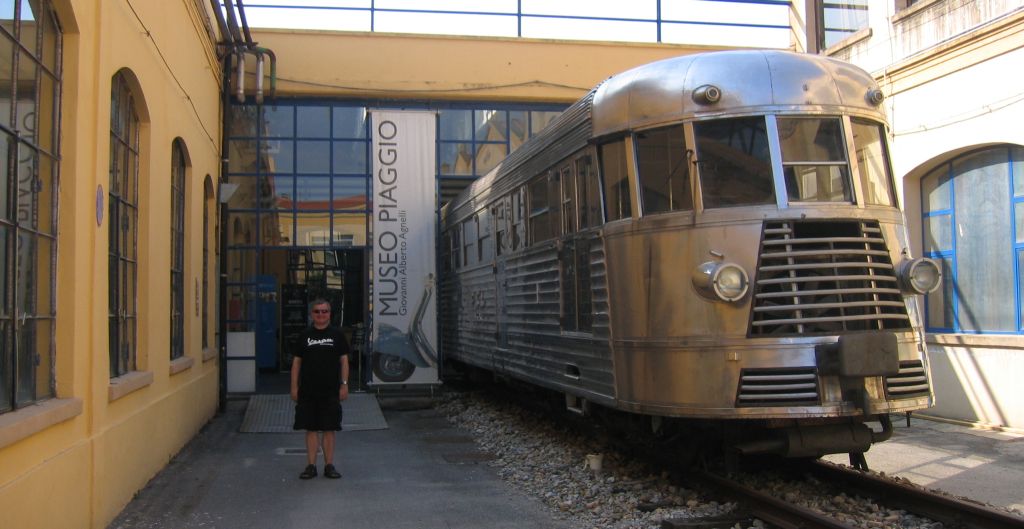
• Entrance to the Museo Piaggio, Pontedera
    Entrance to the Museo Piaggio, Pontedera

    Pontedera (named because it was built near a bridge over the river Era) is a very pleasant little industrial town of about 28000 people, which is the headquarters of the Piaggio company. The buildings tend to be orange with lovely green shutters, and sometimes tiny balconies. The Piaggio factory, established in 1884, produced very stylish trains, and was a major aircraft manufacturer until the end of WWII. Now it is the world’s fourth largest manufacturer of scooters and motorcycles. It is probably most famous for the Vespa scooter, designed by aeronautical engineer Corradino D’Ascanio, the first Vespa being produced in 1946. This design revolutionised two wheeled transportation, and helped put post war Italians back on the road after the devastation of the war.

    As a great Vespa fan, and some time Vespa owner, it was a fantastic privilege for me to be able to visit the site of the original factory, and to be able to see up close the very earliest Vespa models, as well as a great representation of the factory’s output over the years.
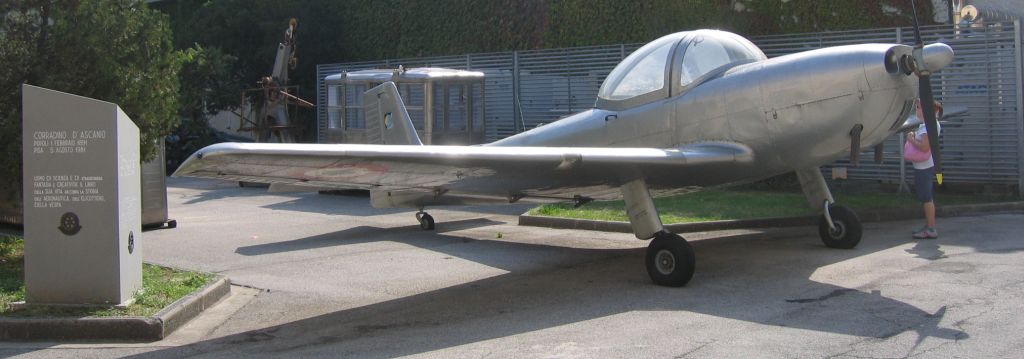
    Memorial to Corradino D'Ascanio, Piaggio aircraft
    Memorial to Corradino D'Ascanio, Piaggio aircraft

    Just inside the entrance there are four or five PX200 model Vespas which have been involved in round the world trips, and have been placed in the museum just as they were when they had finished. It’s a great testimonial to the reliability of the PX200. The next room holds the Piaggio archives, commisioned by Giovanni Alberto Agnelli, and part of a research project between Piaggio and the University of Pisa into the company’s origins. The archive currently holds over 150,000 documents with many on display, for instance the papers drawn up to purchase the land the factory was built on, original designs of the buildings, all the HR documentation that contains the details of all the workers, employees and managers who worked at Piaggio from 1917 to the 1970s. There were newspaper articles about early helicopter designs, Piaggio family marriages, the Pope viewing the 1 millionth vespa, all very well displayed on large posters.
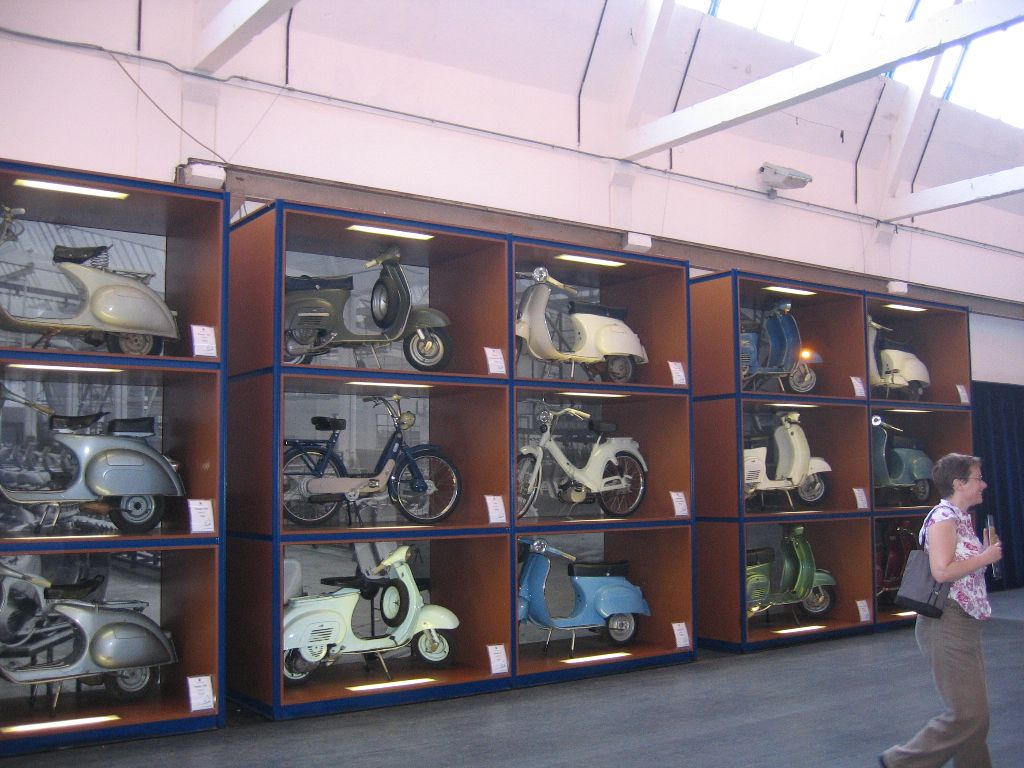
    Showcase of vespas
    Showcase of vespas

    In the next room, there are Vespas everywhere. Above you can see the stand holding a selection of models from over the years.

    Stretched Limo Vespa
    Stretched Limo Vespa

    There is also quite a lot of Vespa art, such as the stretched PX200 above, and lots of classic Vespa advertisements like these ones:

    Vespa advertisements
    Vespa advertisements

    Or how about the Dali Vespa? In 1962, two Spanish students rode from Madrid to Athens, stopping at Cadagues where they met Salvador Dali, who decorated their Vespas for them. When they reached Rome, they were apparently directly received by the Pope.
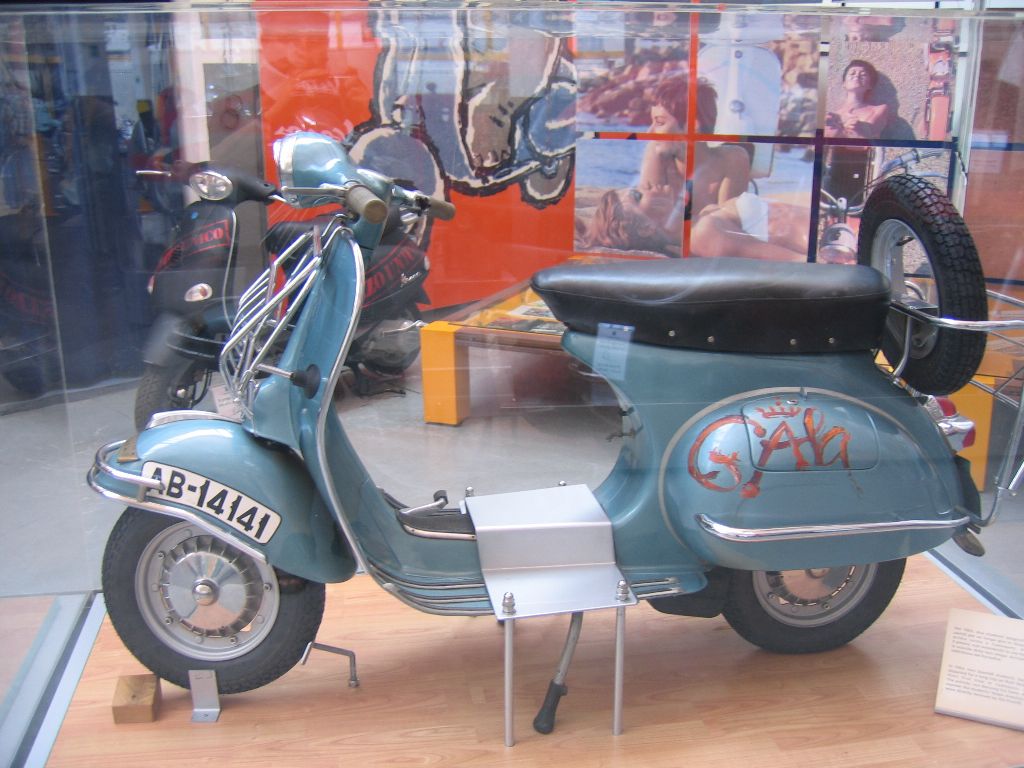
    Salvador Dali Vespa
    Salvador Dali Vespa

    Here’s an aerial view showing some of the very earliest Vespas, and also some Apes (three wheeled Vespas) including a very nice Ape fire engine.

    First ever Vespas in foreground on left
    First ever Vespas in foreground on left

    There was a lot to see, we spent most of the day there apart from when we went to Pontedera railway station to collect Pauline’s colleague James Green, who was attending a conference in Pisa. Here’s a few more photos:

    Vespa Rally models - highly desirable
    Vespa GS and two Vespa Rally models – all highly desirable
    F1 driver Gilles Villeneuve on his Vespa
    F1 driver Gilles Villeneuve on his Vespa
    Pauline admiring the Dali Vespa, note giant PX200 on right
    Pauline admiring the Dali Vespa, note giant PX200 on right

    In the picture above, you can see the giant PX200 designed for a motor show in the 1980’s, also the flying Vespa which was made for a spy movie in the late ’60s.
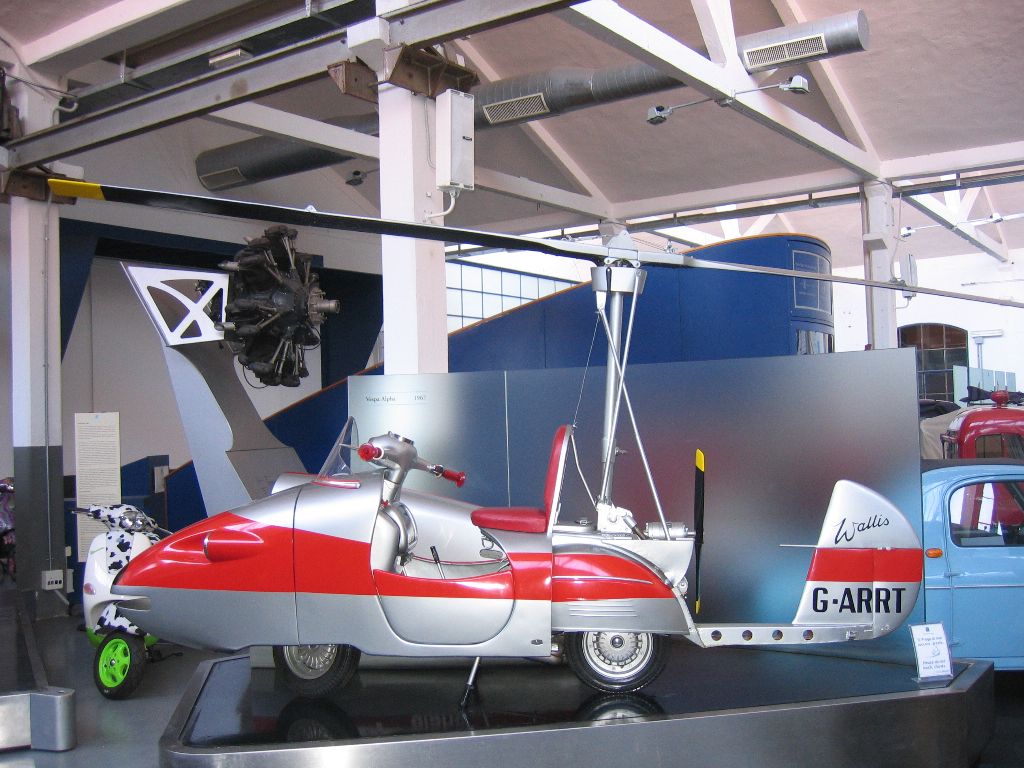
    Flying vespa made for the movie Dick Smart, Agent 2007, 1967
    Flying Vespa made for the movie "Dick Smart, Agent 2007" 1967
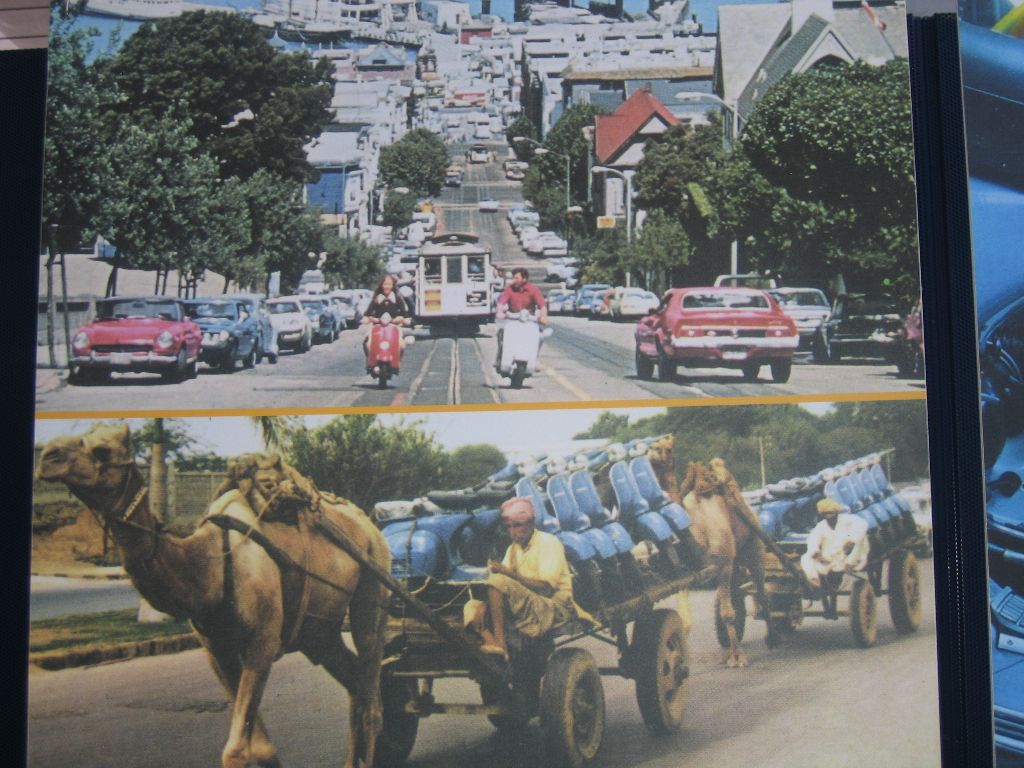
    Vespa delivery, India
    Vespa delivery, India and Vespas in SF

    We really enjoyed our time at the museum, well I did anyway, and we managed to purchase some Vespa mementos at the bookshop on the way out, so it was a very successful day. And, if I now buy a new Vespa when we get home, Pauline will not be able to act surprised!

    Next – off to see the famous leaning tower in Pisa.

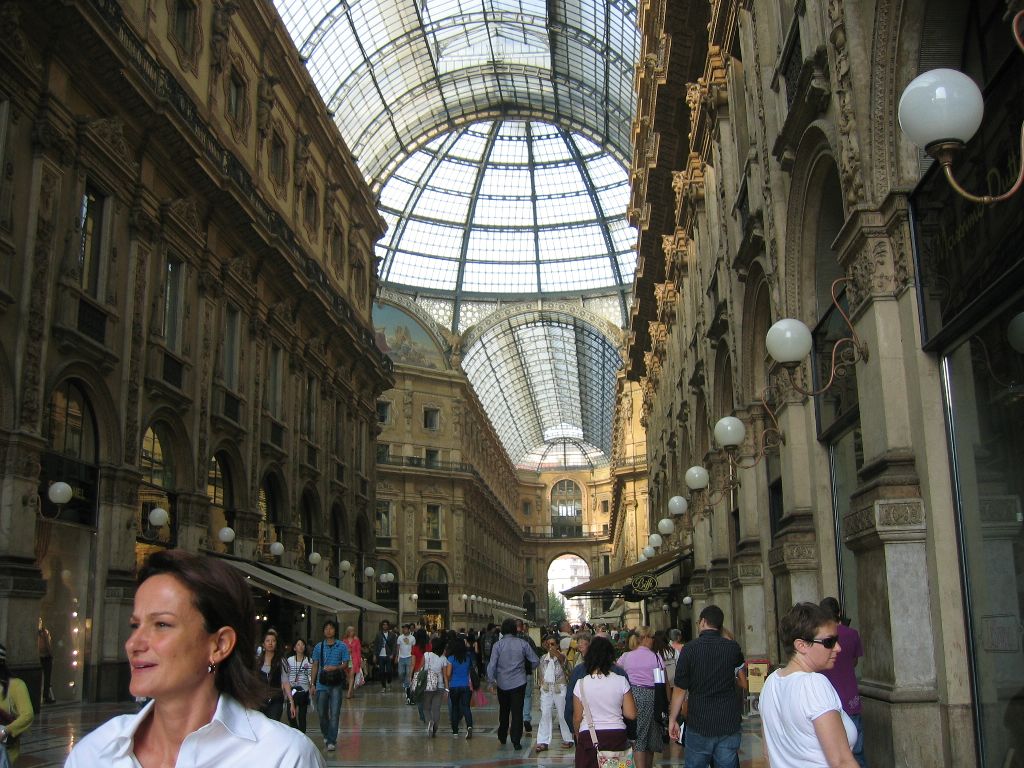
  • Inside the Galleria Vittorio Emanuele II
    Inside the Galleria Vittorio Emanuele II, Milan

    We were staying in the Ibis Milano Ca Granda, a 15 minute tram ride from the Stazione di Milano Centrale depending on the traffic. The hotel was ok but a bit quirky in an Italian manner, for instance Pauline asked if she could borrow an iron, as she wanted to iron some clothes to wear to her conference. The receptionist replied that they did not have an iron, as the hotel was not finished yet! We  thought this was a bit odd. Luckily the adjoining hotel was owned by the same group of companies and we managed to borrow an iron from them.

    While Pauline was at her conference, I concentrated on fixing my neck, and just pottered round our local area. One day, I was at a local laundromat doing our washing. The owner took it upon himself to teach me italian while I was waiting, starting with the alphabet and how to pronounce the vowels and syllables, then progressing to numbers and words. Eventually an english speaking lady came in, and she explained to me that the owner would talk the hind leg off a donkey, and my best strategy was to pretend not to understand a word of italian and ignore him. However I thought he was quite nice and enjoyed the lesson.

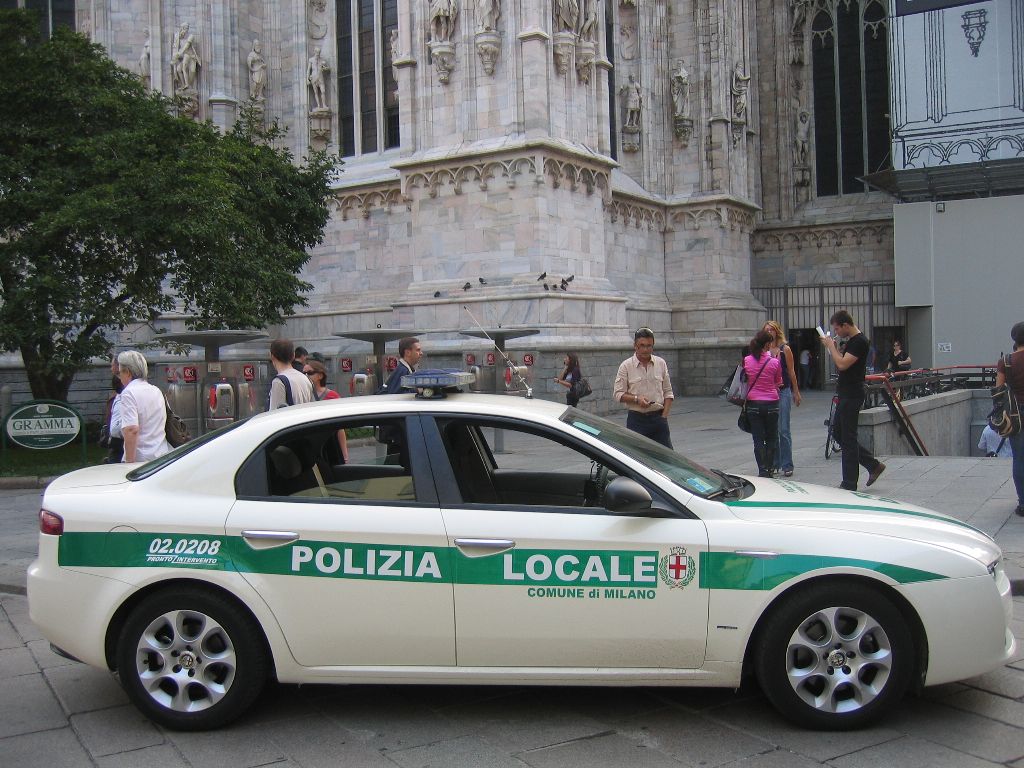
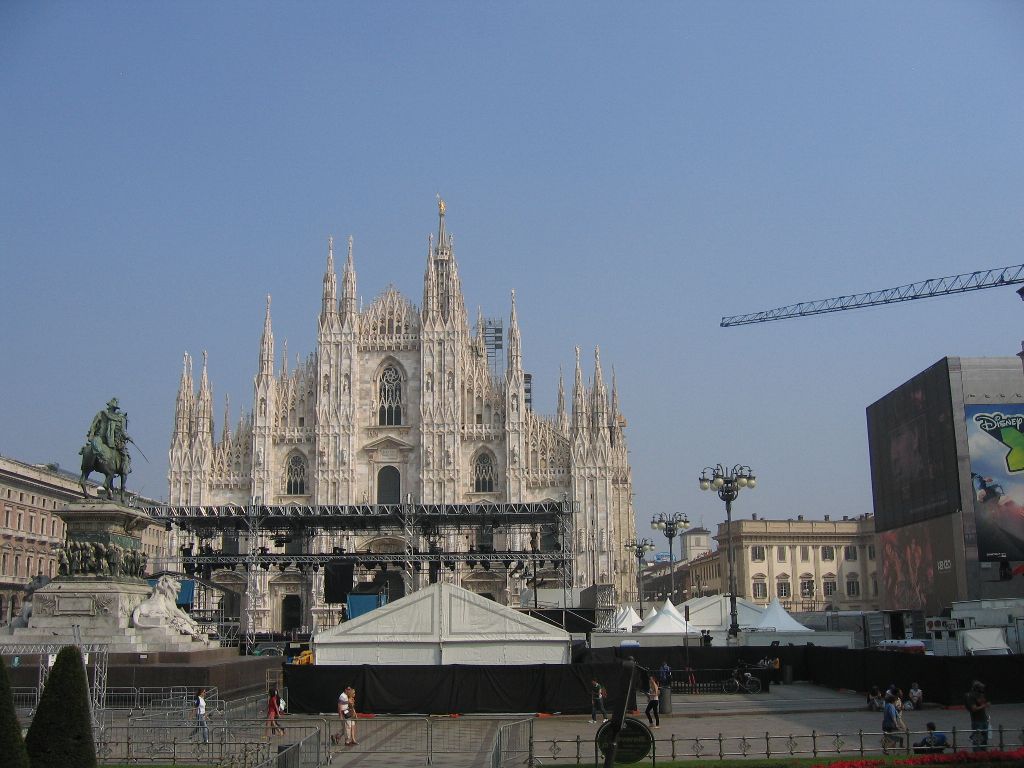
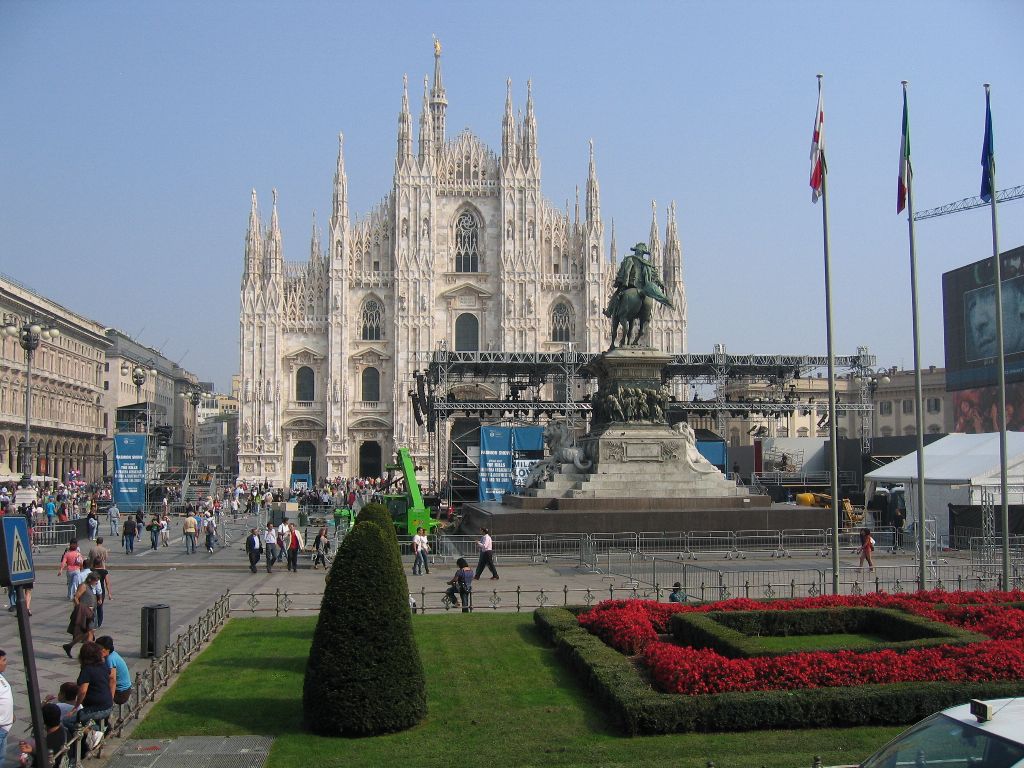
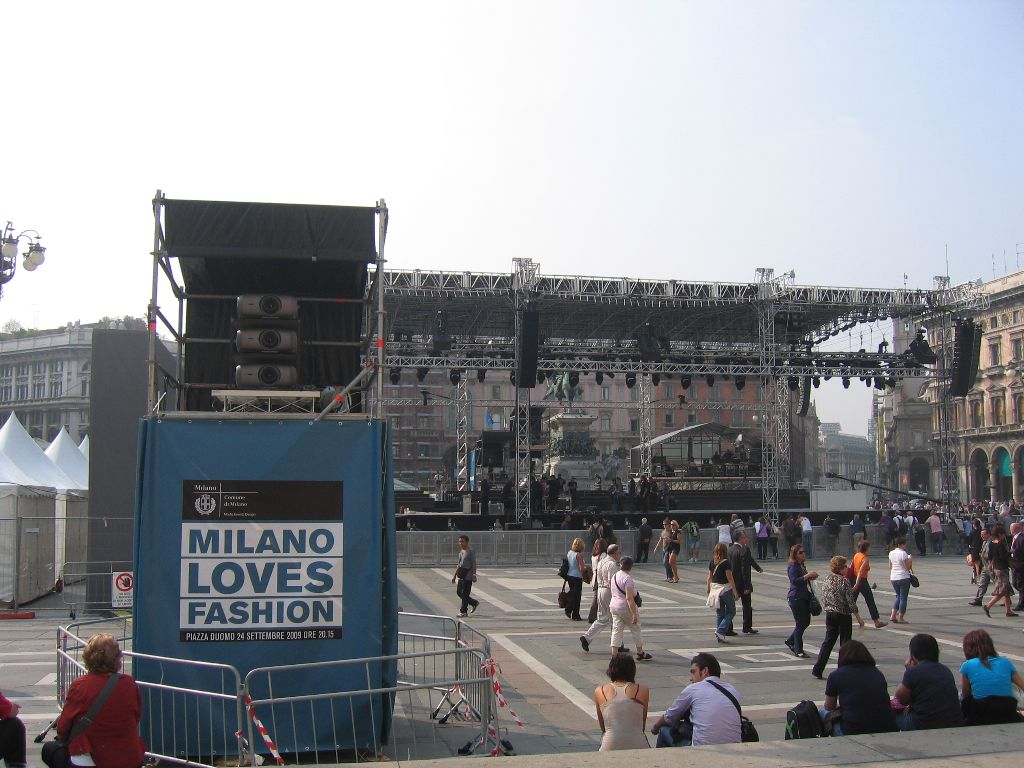
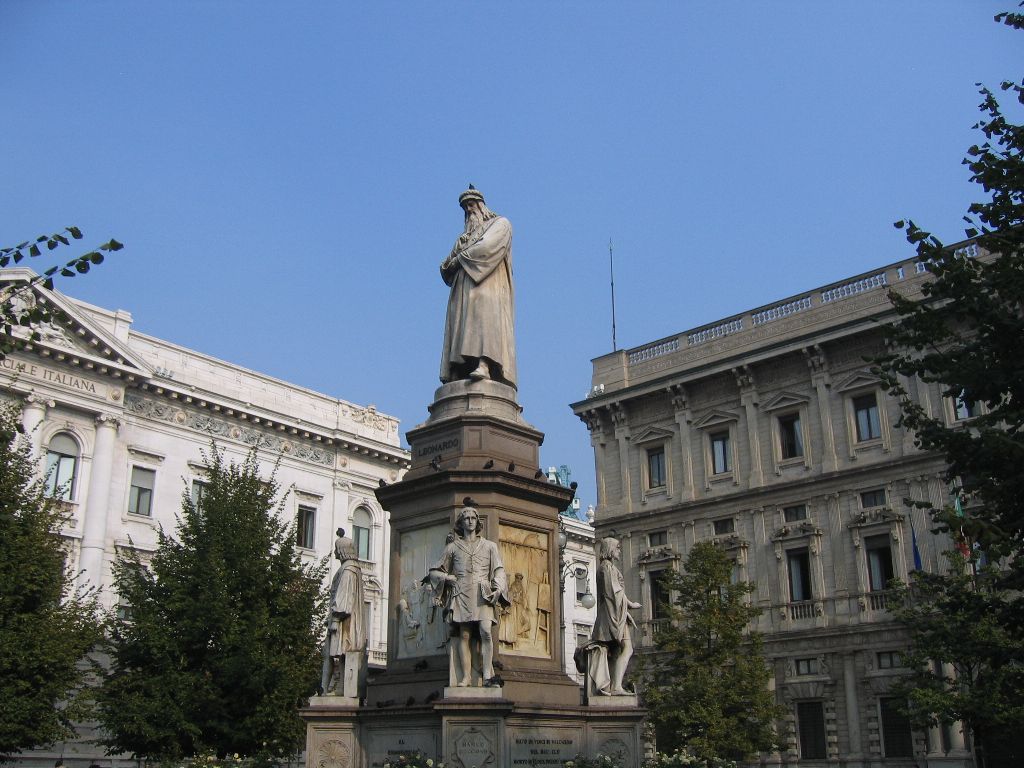
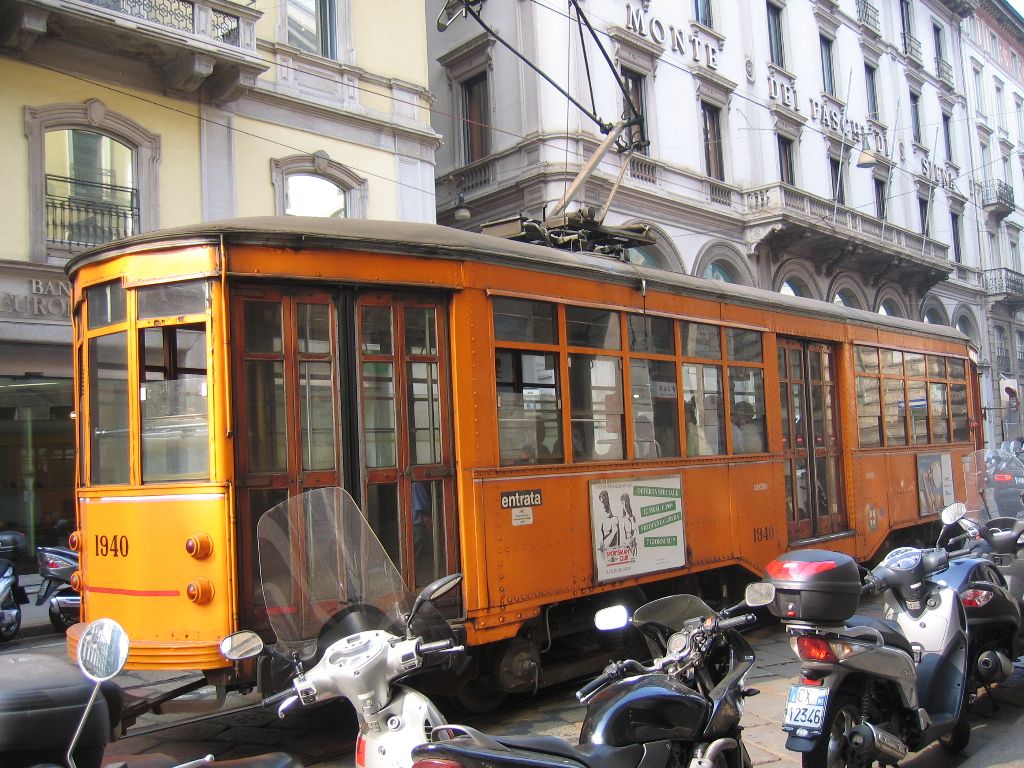
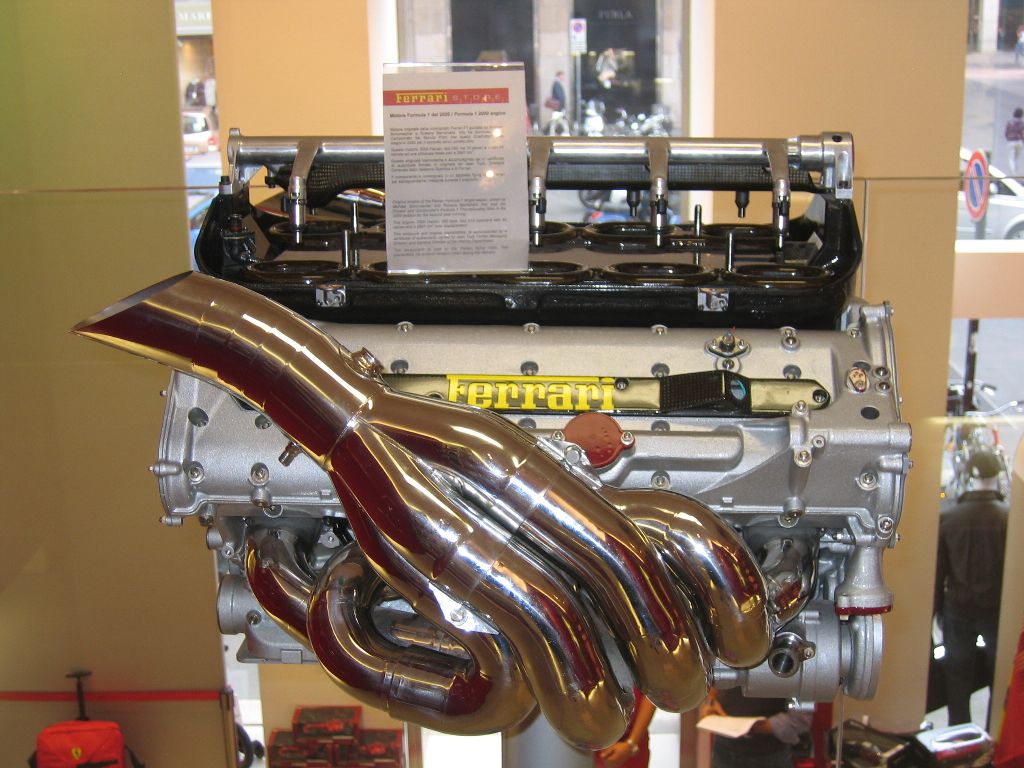
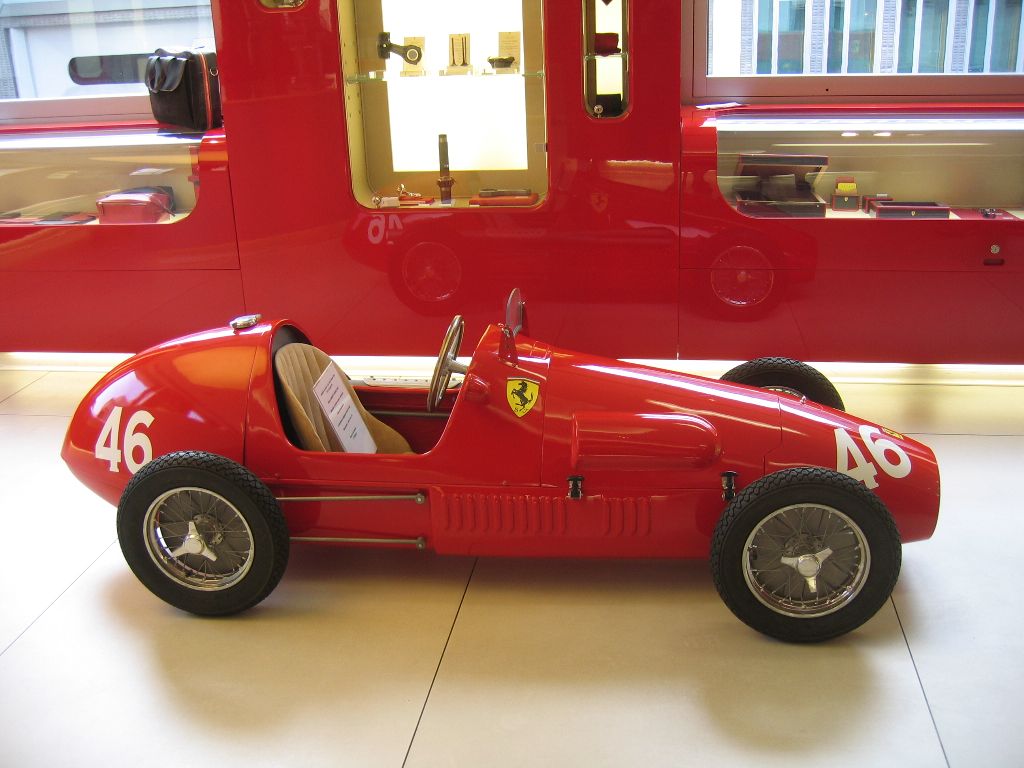
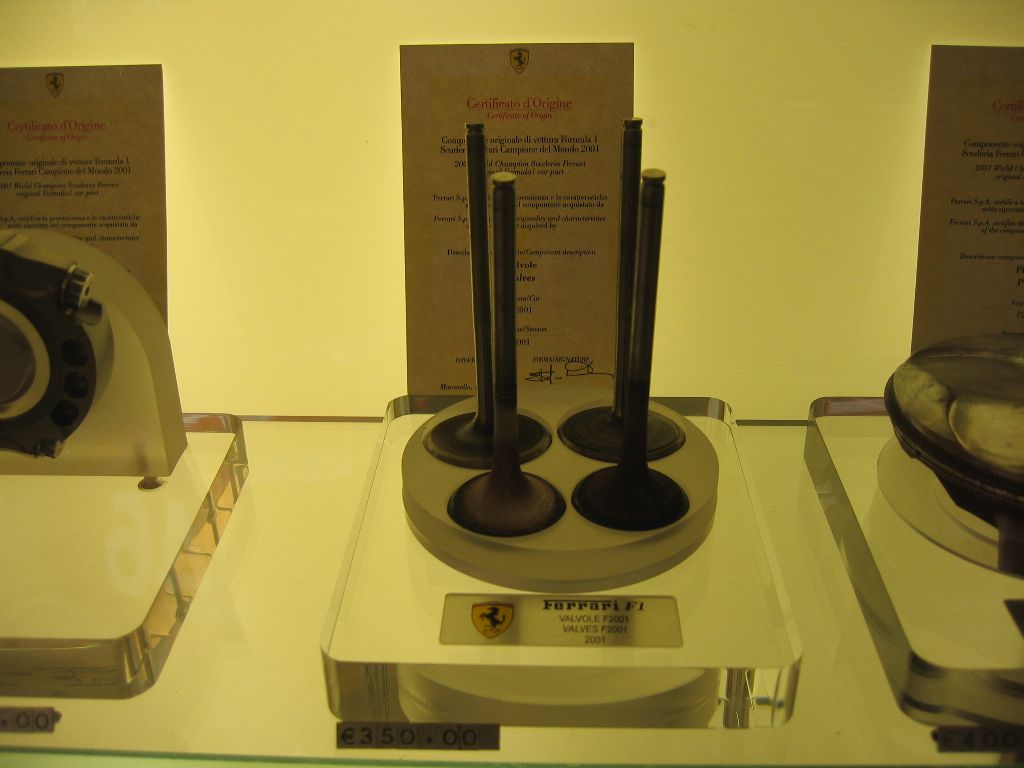
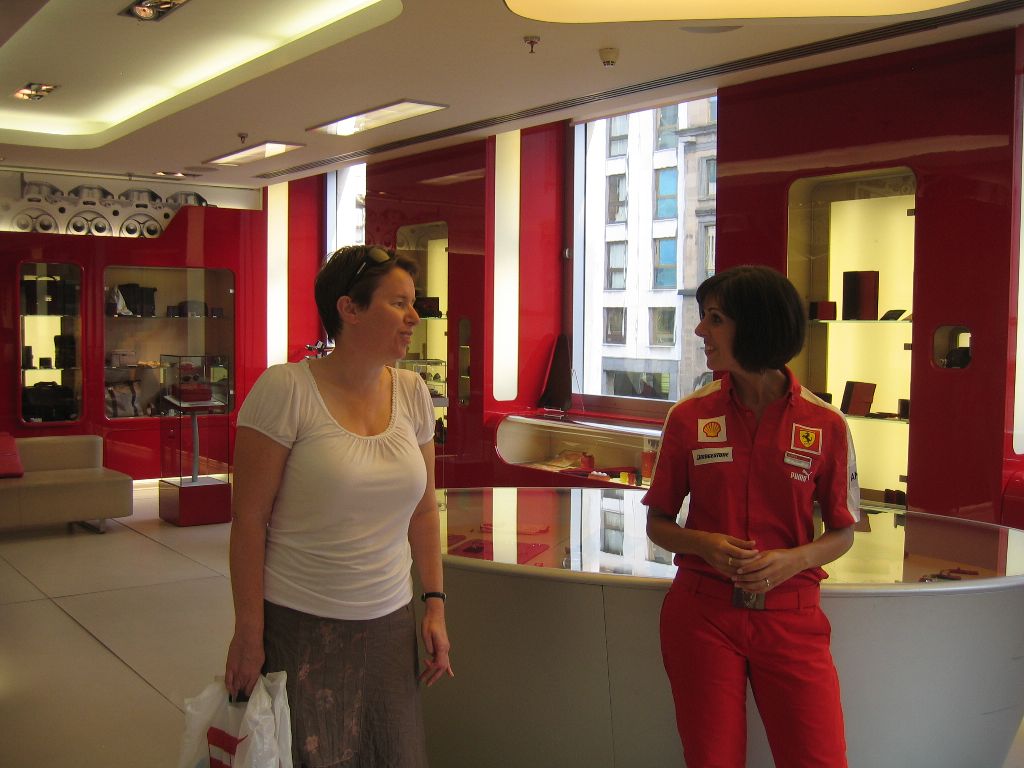
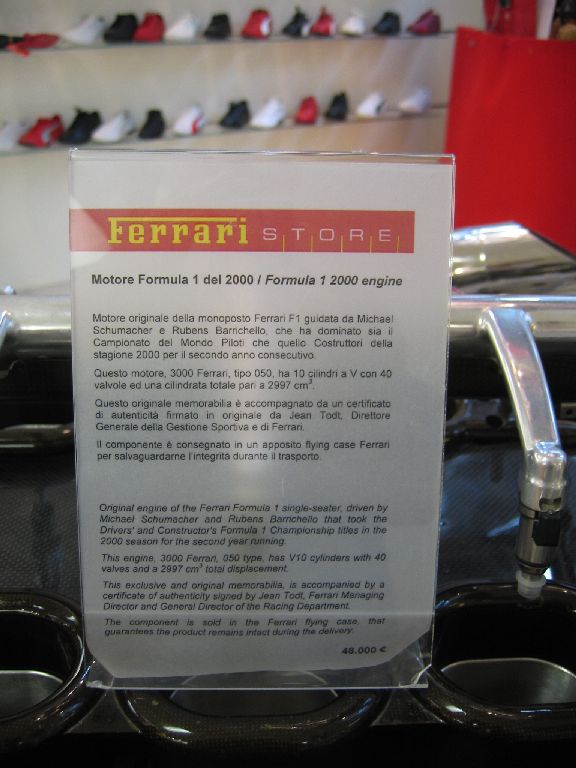
    At night we would catch the tram or bus into the Stazione Centrale, and explore a little. We found various restaurants to try, including an excellent chinese buffet restaurant about 5 minutes walk from the station. On the last day in Milan Pauline’s conference was over so we had time to explore a bit more. The Piazza Duomo is spectacular, there was some sort of fashion event happening there at nights so they had a stage with bands doing sound checks, and a giant screen. The Duomo itself is the fourth largest church in the world. It took five centuries to complete, starting in 1386. It certainly is a most impressive structure.  On the north side of the square is the Galleria Vittorio Emanuele II, a beautiful covered double arcade full of elegant shops, named after the first king of united Italy.  Not far from the Piazza we discovered my favourite part of Milan which was the Ferrari shop! Here, you could buy a complete used Formula 1 Ferrari engine for your coffee table, for a mere €48000. Also, various items of clothing, ferrari sunglasses, luggage, models, and other engine parts. It was a fantastic place.

    The city is rather busy, the traffic is appalling, and it was time to head to Pontedera. Here’s some photos.

    Galleria Vittorio Emanuele II

  • After leaving the hospital, suitably braced for the trip so to speak, we took the Citroën up the east coast of Spain to a little seaside resort town in France called Sète. In Sète we found a comfortable hotel near the beach, and wandered to a nearby restaurant for dinner. I ordered Moules et Frites, and Pauline ordered Carpaccio. This was unfortunate for her, as Carpaccio turned out to be  huge plate of thin slices of raw marinated beef. Luckily the waitress was very nice about it, and gave her another choice. When we came to pay the bill, she did not charge us for the Carpaccio, saying she had eaten it herself instead! So we gave her a big tip. It was quite nice to be back in France, it is an odd feeling being in a country where you really can’t understand the language. We could manage to read a bit of spanish but it wasn’t easy to understand the spoken language.

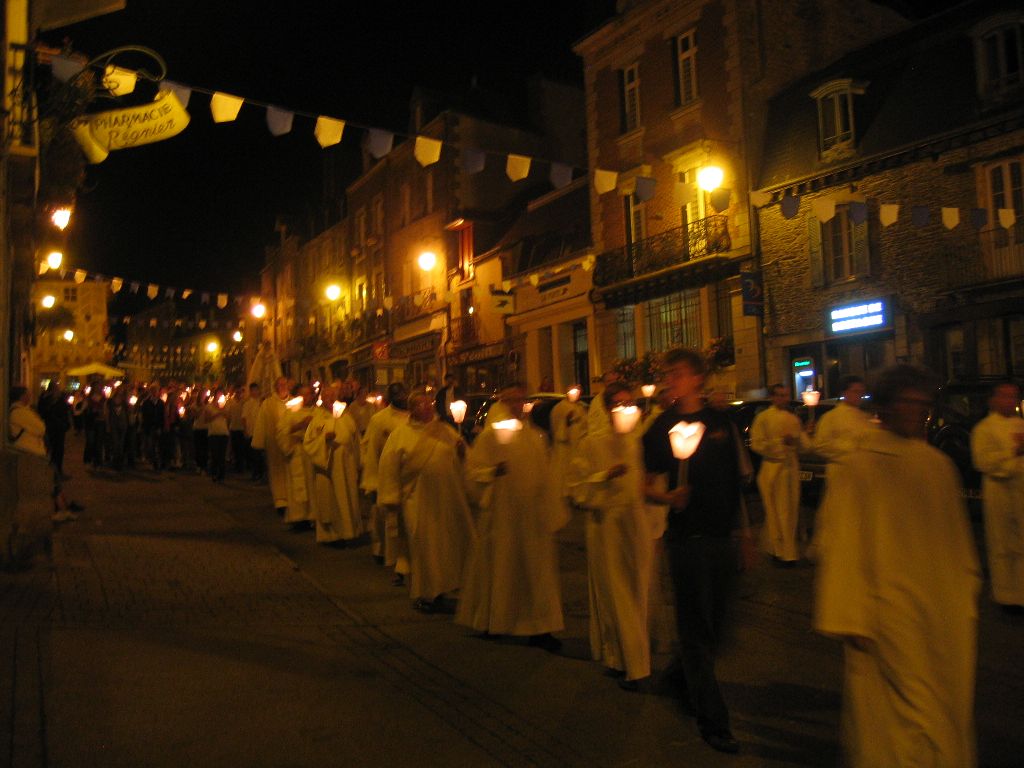
    The next day was a fairly big drive,  about 7 hours, driving past Marseille, Cannes and Monaco. Around Monaco we were driving down a mountain pass for a while, it was spectacular, with great views of the coast, and the mountains, and the rich people in their fancy cars off to do a bit of gambling no doubt. Inexplicably, once across the border into Italy, the drivers all became far more flamboyant, and drove much faster. I had to concentrate reasonably hard and pay attention to people coming up behind us at a rate of knots. We arrived in Milan about 7:30 at night, and the driving in the city was also fairly exciting. I can’t say I enjoyed it too much at that point of the day. But we got there in time for Pauline’s conference, we found the hotel, checked in and I could put my feet up with a certain amount of relief. Of course, for Pauline, the work was about to begin.

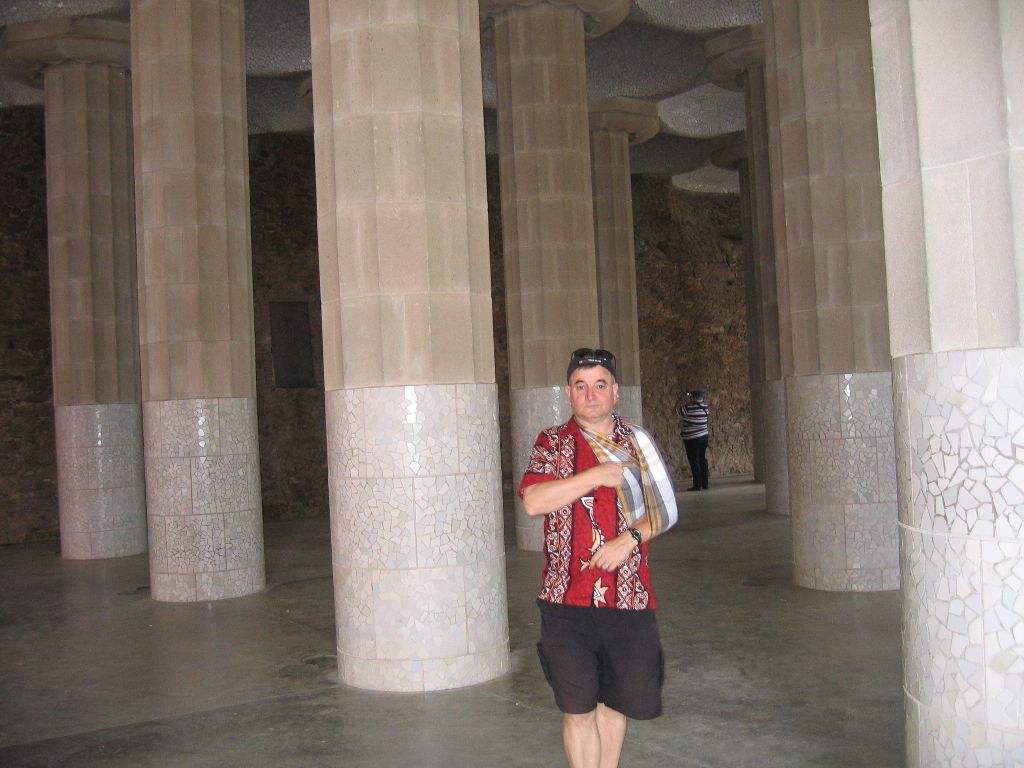
  • First of all, I apologise for the tardiness of this blog. When we got to Barcelona, I was starting to get considerable pain from my left shoulder, which I thought I must have hurt in Bordeaux by sleeping on it, as it is the one that I had an operation on when a young feller to stop it dislocating. I figured it would get better over time but each day it was getting worse. So we tried a sling. The sling did not help however so on the last day in Barcelona

    Pod in Park Güell
    Pod in Park Güell
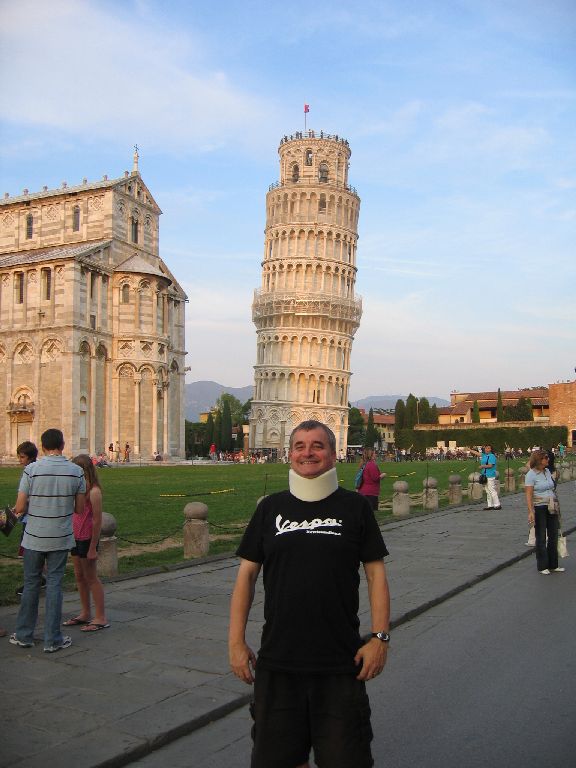
    Pod with neck brace
    Pod with neck brace

    instead of heading off to Milan, we went to a private hospital and got it checked out. The A and E was immaculate, we only had to wait a bit over an hour, the doctors were very nice and kept apologising for their english, but as we pointed out it was far better than our spanish! Anyway they x-rayed me and said everything was fine but I’d hurt my neck and gave me a whole lot of pills to take (muscle relaxants, anti inflammatories, pain killers,) plus a neck brace to wear. The thing is, although these all helped a great deal, it was impossible for me to sit for very long at the computer. In Milan, I spent the first day or so lying on my back in the hotel room. This was a shame, as after Milan the internet access we had was either tremendously expensive or limited access, or not working. So, sorry about that! Thankfully, it’s pretty much all fixed now.

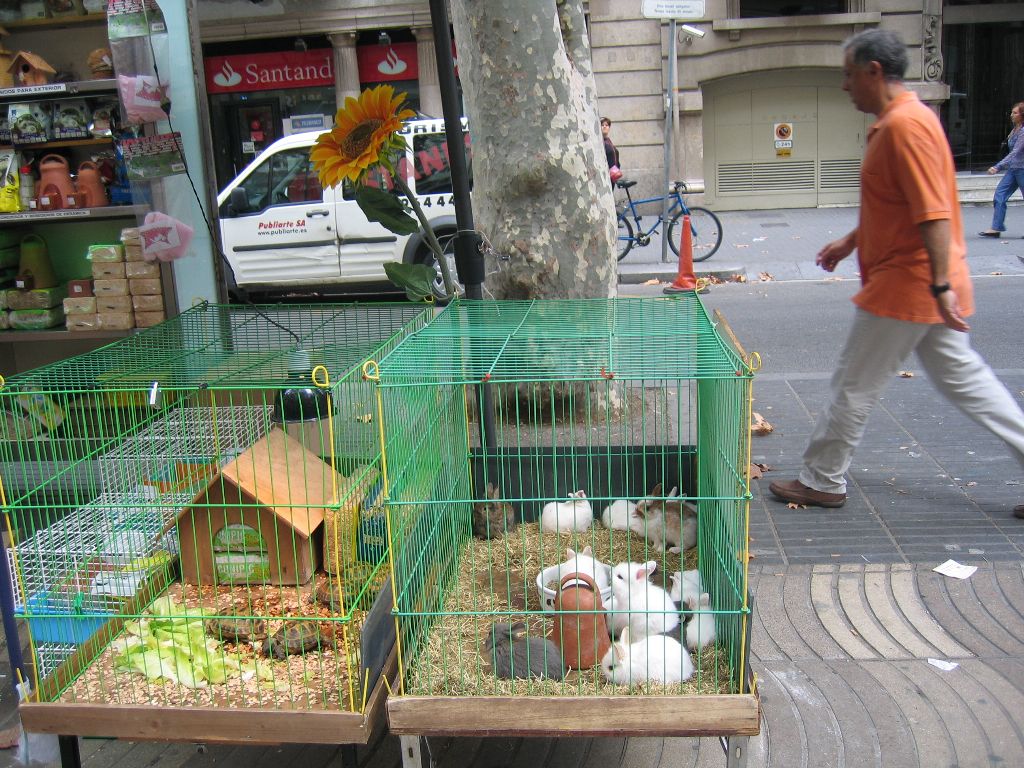
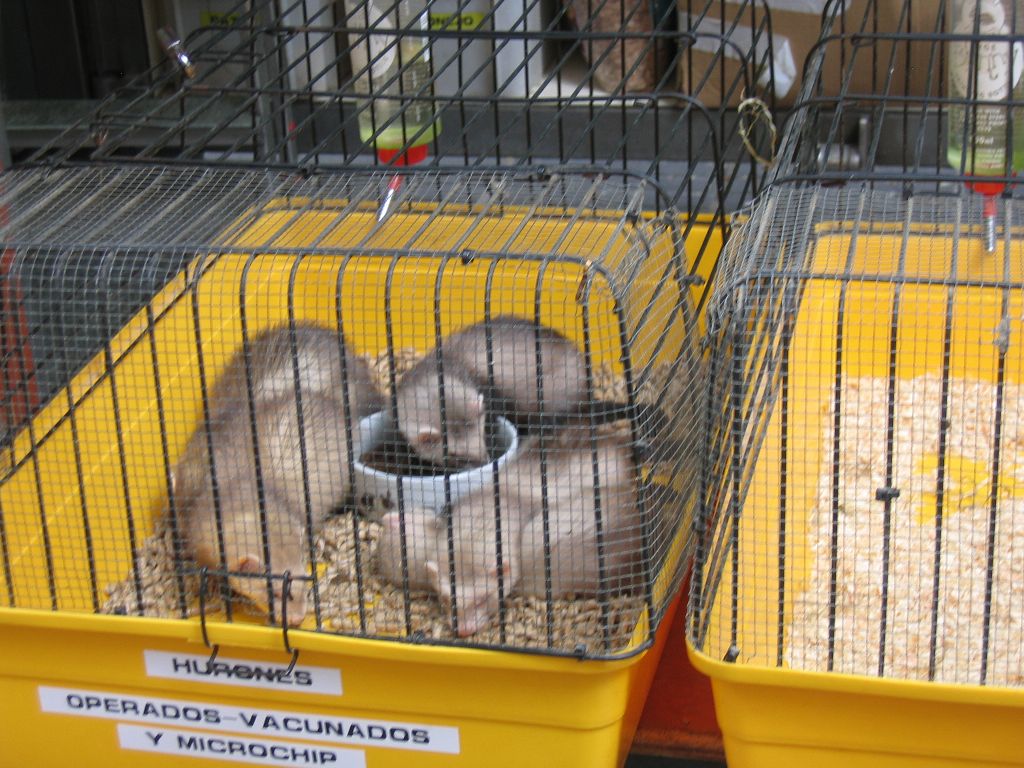
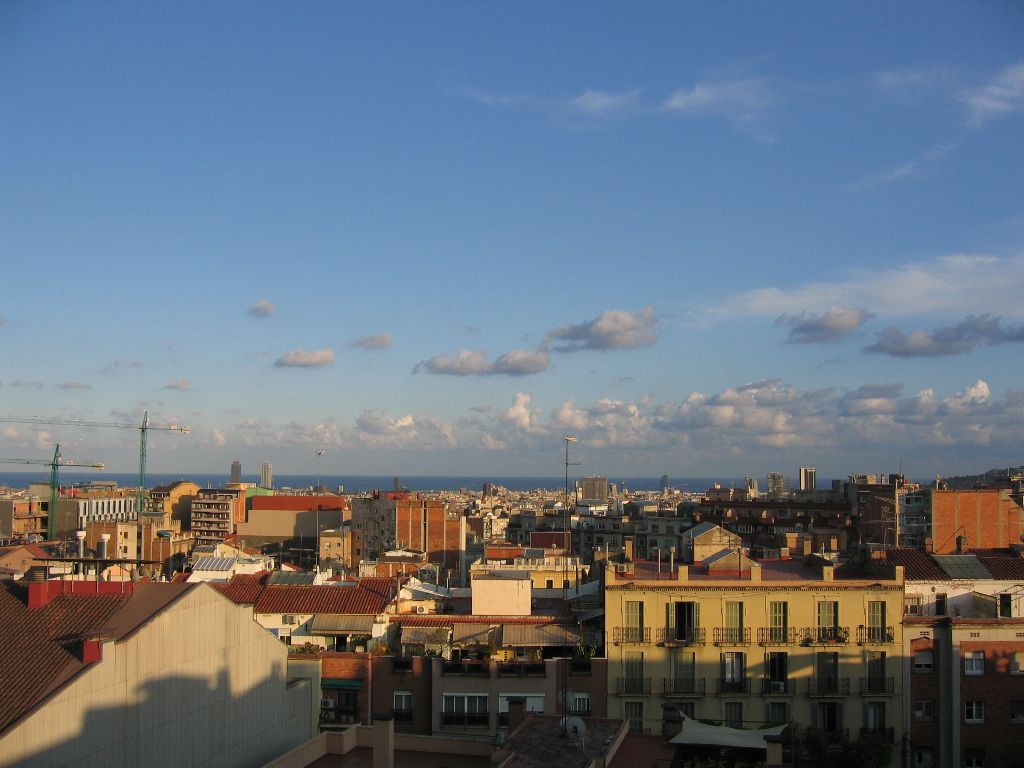
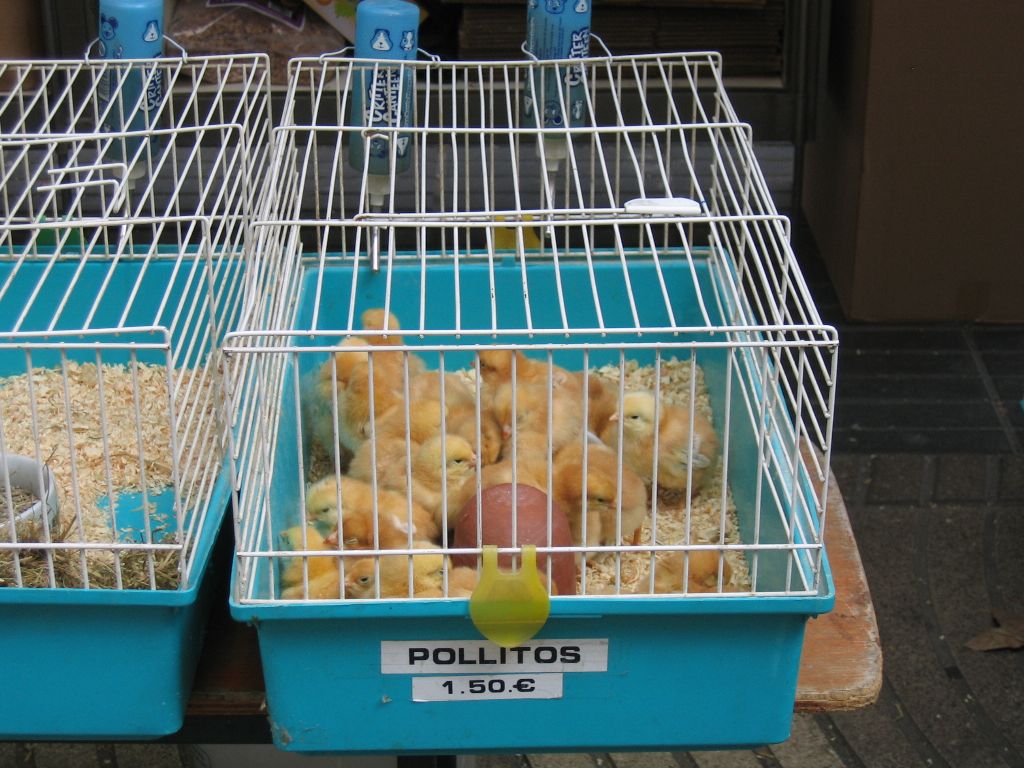
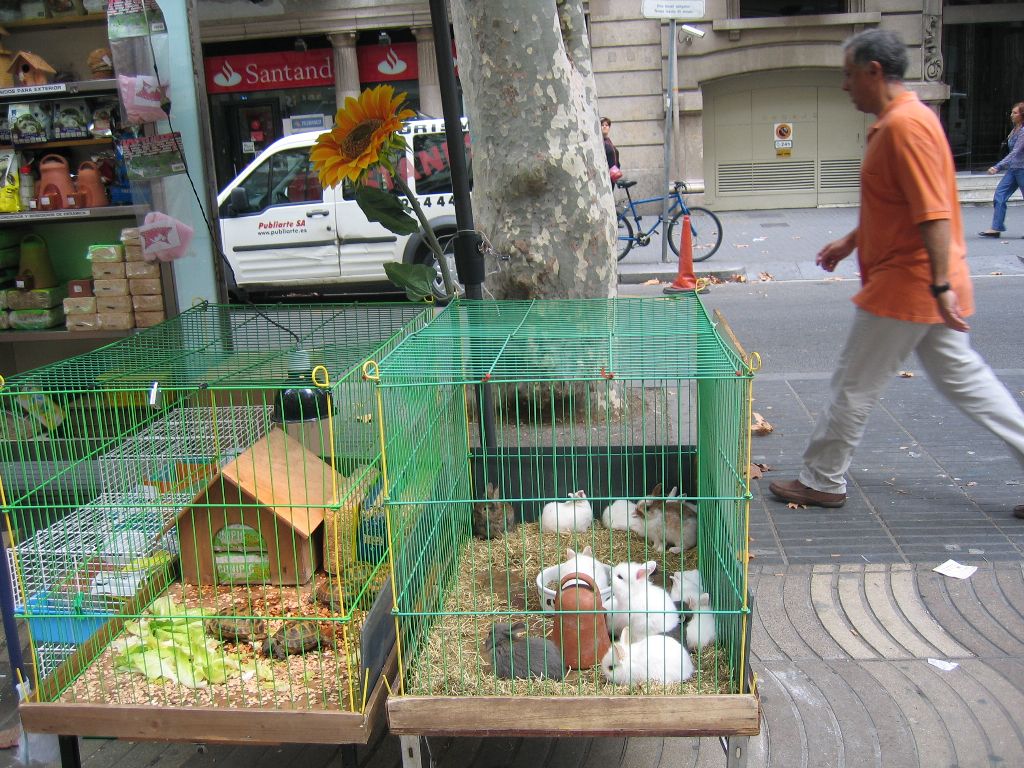
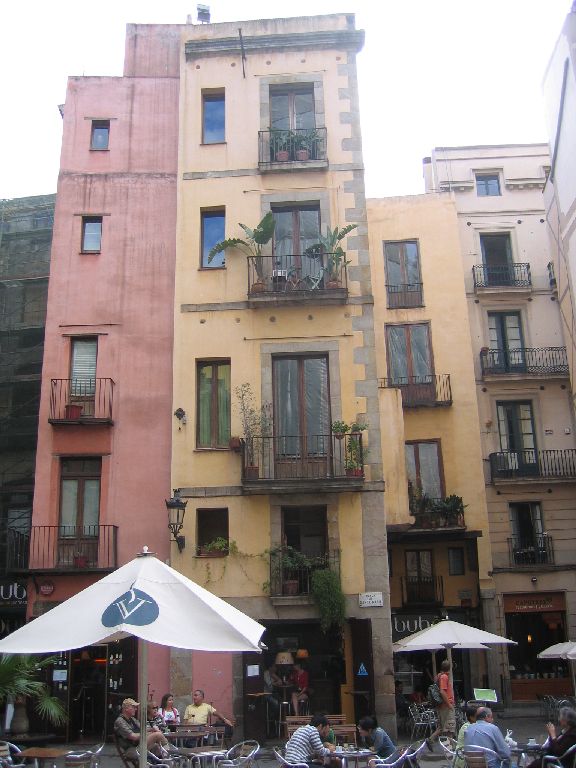
    In Barcelona, we lived in a suburb called Puxtet. There was a subway about 15 minutes walk away, from where it was a couple of stops to Plaça Catalunya, pretty much the city’s historical centre. From there, we caught a double decker sight seeing bus which you could get on and off at will. This is an excellent way to see a new city, and learn a bit about it. First though we wandered down the shopping street, La Rambla, admiring the different birds and animals for sale in the centre division.

    Rabbits and Turtles for sale
    Rabbits and Turtles for sale
    some sort of weasels
    some sort of weasels

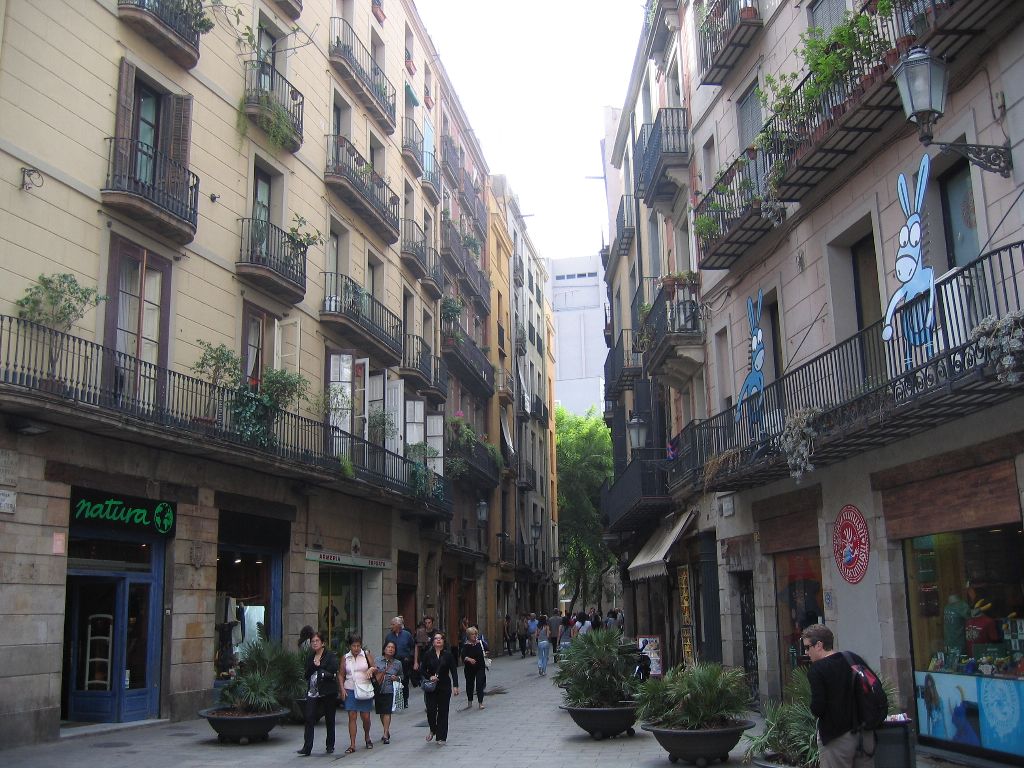
    In the city, I particularly liked the Barri Gòtic (Gothic Quarter)

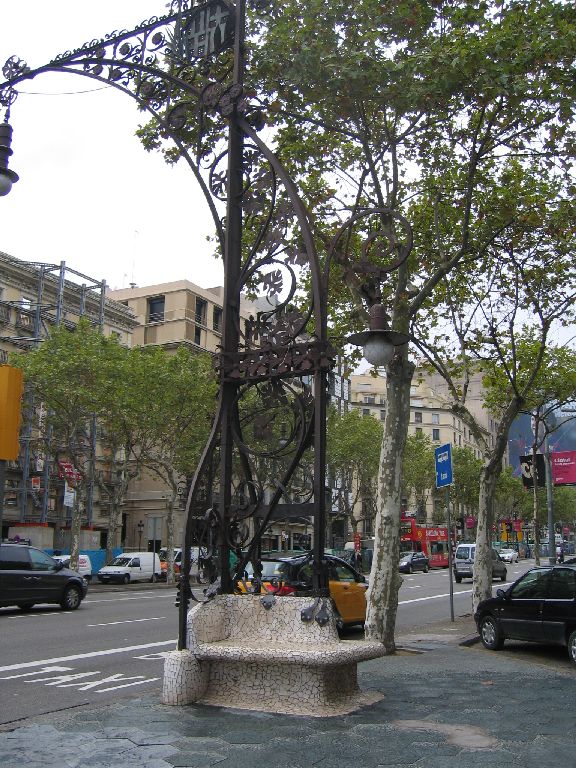
    The outstanding architecture in this quarter, much of it from medieval times, is complimented by that of the modernisme movement, exemplified by the buildings of Antoni Gaudi (25 June 1852–10 June 1926.) I’ve admired Spanish architecture since we went to Cuba, and I certainly was not disappointed with what we saw in this city. Here’s a few more pictures:

    Seat and street lamp
    Seat and street lamp
    Gaudi house details
    Gaudi house details

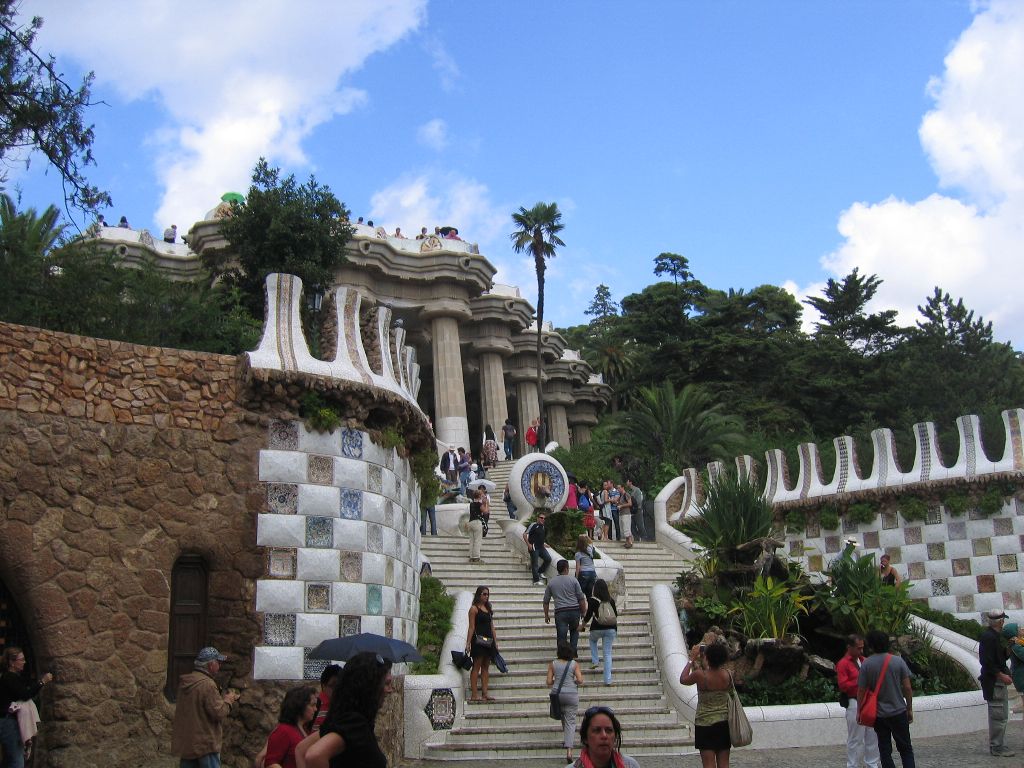
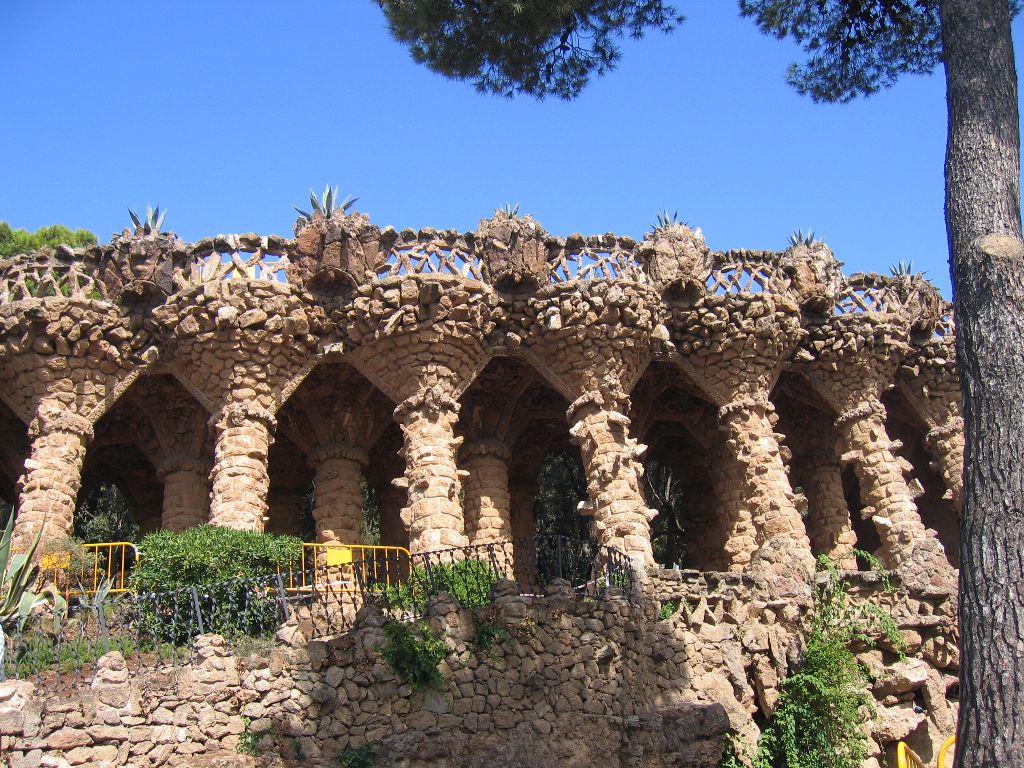
    The following day we walked to Park Güell which was about 20 minutes walk from Puxtet. I’ve inserted links to the wikipedia articles, but briefly, Park Güell is a garden complex designed by Gaudi and built in the years 1900 – 1914.

    More Gaudi houses
    More Gaudi houses
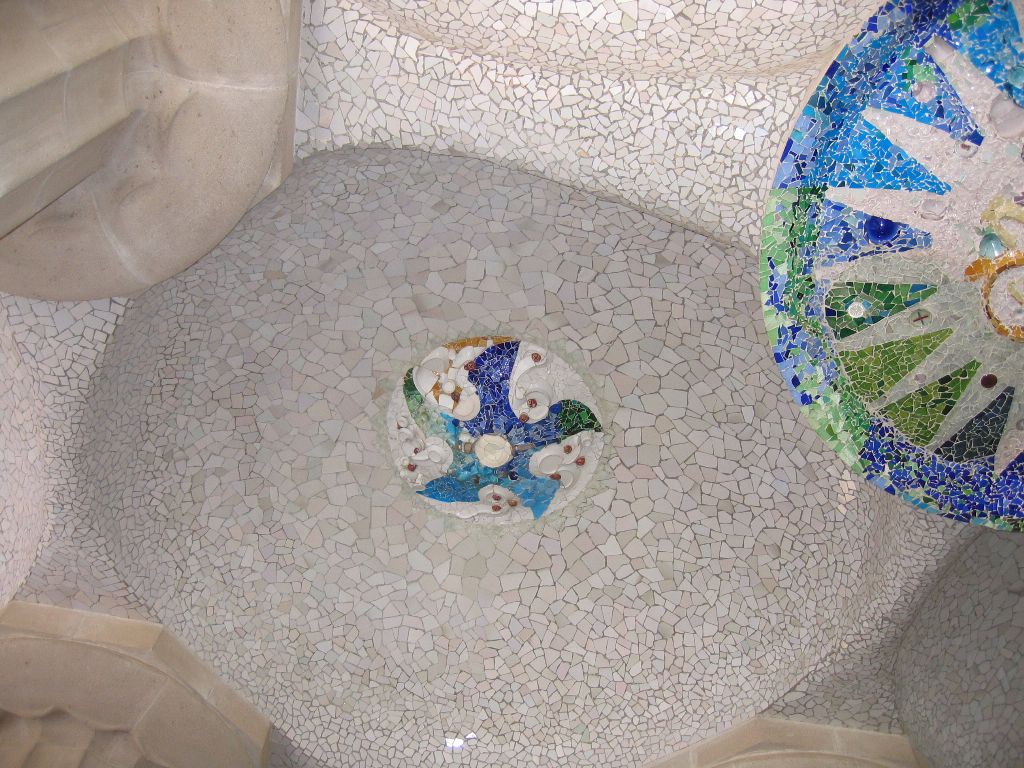
    Mosaic work, Park Güell
    Mosaic work, Park Güell

    Gaudi’s final work, which is still ongoing, was a church, the Sagrada Família. It has been under construction since 1882 and is not expected to be completed until at least 2026. It is a quite astonishing, not to say mad looking, structure. Here’s a couple of photos, it was rather difficult to photograph.

    Sagrada Família
    Sagrada Família
    Sagrada Família
    Sagrada Família

    We were very much taken with Spain, and I’d like to go back some day. Amazing country. The people are very upbeat, kind of chirpy. The food was great, although I still haven’t had a paella there. And the hospital service was beyond reproach!

    Park Güell
    Park Güell
    Park Güell
    Park Güell
  • We noticed immediately that the Spanish countryside was quite different to France, a lot dustier and the architecture was very Spanish, we passed houses that reminded me of early westerns actually, there was even one called “The Ponderosa” as in Bonanza if anybody still remembers that great TV program. It was fascinating driving through this alien landscape, very odd rock formations, lots of vast dusty plains. We stopped for lunch at a truck stop, had the usual bread and cheese and ham etc, then on to Barcelona. Pauline was working on her laptop, so she made good use of the five and a half odd hours it took us to get there.  The driving was pretty easy really as we were on a two lane highway with a 120 kmh speed limit and not a lot of traffic.  The biggest pain was having to stop every now and then to pay tolls. The cost of driving in Europe can be horrific. We would have spent about 25 euros on diesel getting to Barcelona I guess, and about 40 euros in tolls! Anyway, once we were approaching Barcelona, the traffic increased and in the city the driving was unbelievable. As Pauline said referring to the GPS display, ‘it looks like spaghetti.” There were motorways going everywhere, often we would drive into a tunnel going under other motorways, and of course we would lose the GPS signal when that happened, so we had to be on our toes when we emerged, as we were constantly exiting one motorway and joining another. Finally we left the motorway system and plunged into the city streets. There were cars everywhere, it was about 5pm and the Spanish make the French driving style look rather sedate! As we approached our hotel which was in an urban area near the hills, the roads became extremely narrow and often one way only, sometimes very steep. Still scooters were zooming past cutting in and out of the traffic, cars were tooting etc etc. I was very pleased when we finally found the hotel. However, when Pauline went to book us in and find out about parking, they had never heard of us. So it took her about 30 minutes of discussion until they found the relevant paperwork and we could put the car to bed and find our room. The room was on the 5th floor and had a balcony with an excellent view of the city, so that was a saving grace. Otherwise, I’d have to say it wasn’t the most organised hotel. We had a bit of a rest, then a walk to a local park, then had tapas for dinner at the hotel and a well earned drink!

    Here’s a few photos – more on Barcelona next post – we loved it!

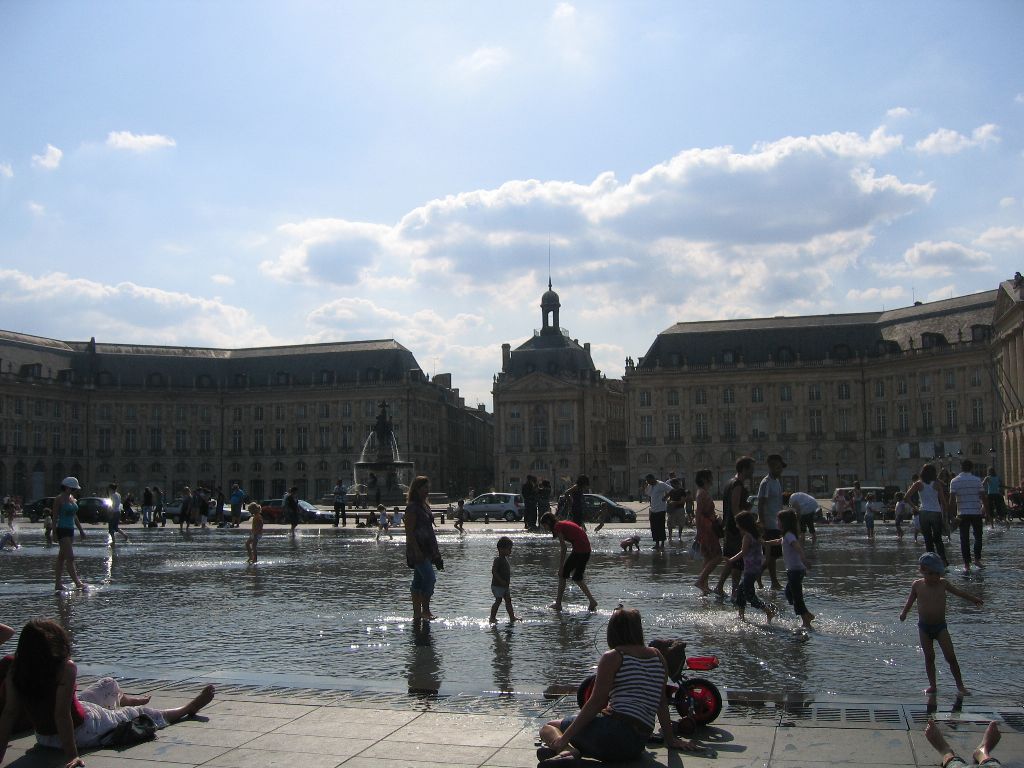
  • Well we’ve done it slightly hard, really, as in Bordeaux Pauline and I were both felled by a really bad cold, and we ended up staying there an extra day as we were not up to doing much. And for some reason I injured my neck the first night, possibly as I was sleeping in odd positions to try and breathe with my blocked nose. This was to have far reaching consequences. Bordeaux seems really nice, and of course there’s lots of wine tasting to be done in the area. Not for us this time! We settled for an open air bus tour, and one day we caught the tram into town and took a walk by the river. The weather was warm, and the children were out in force on this unusual fountain arrangement which sprays enough water to have a couple of inches in which the children run and slide and splash and generally keep cool. In the background is one of the doors to the inner city, with a famous statue of some sort. We mostly concentrated on getting better so not many pictures I’m afraid.

    funny fountain arrangement
    funny fountain arrangement
    Water mirror by the Garonne river, Bordeaux
    Water mirror by the Garonne river, Bordeaux

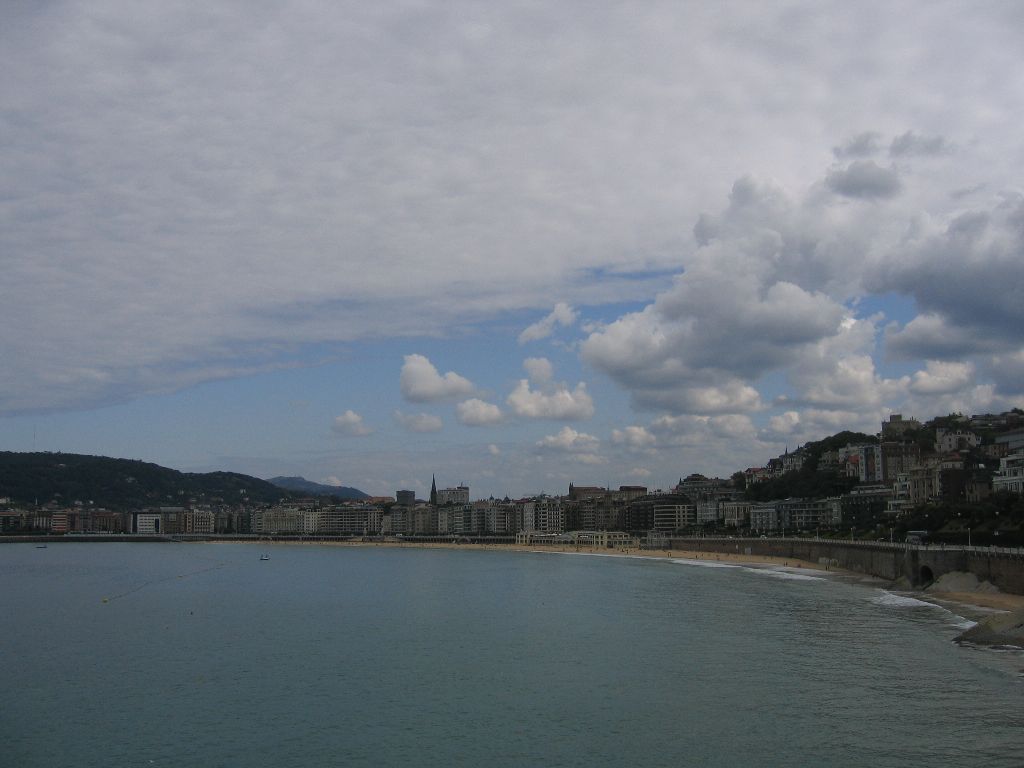
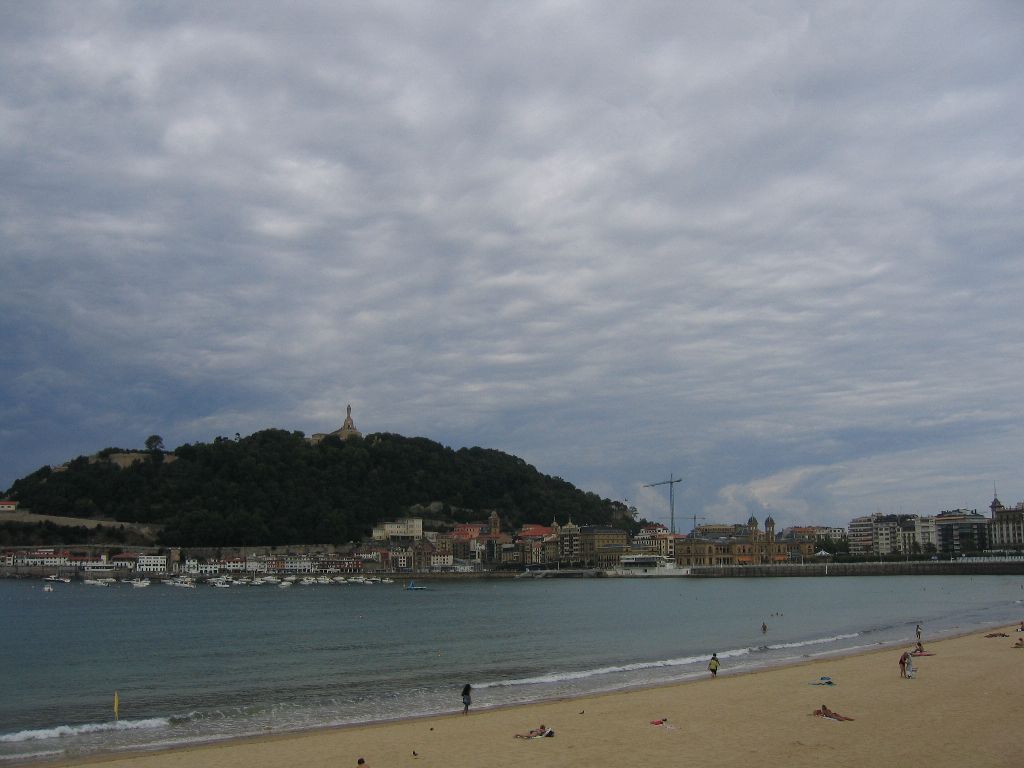
    Then it was time to head for Spain, which I was really looking forward to, never having been there.  we decided to head for San Sebastian, a coastal town only a couple of hours from the French border, in Basque country on the southern coast of the Bay of Biscay. The drive was easy on the French side, a bit more challenging on the Spanish side as we were skirting round the feet of the Pyrenees, and the road was fairly twisty. We had found an excellent 4 star hotel on hotelclub for less than half price, and we were very pleased to get there. The hotel room had a nice big comfortable bed, and a balcony with a table we could eat our breakfast at, the staff were extremely nice and spoke good english. The next day, we took the bus into town. The header at the top of the blog currenly shows what the bay looks like, also here’s a couple of photographs.

    The bay
    The bay

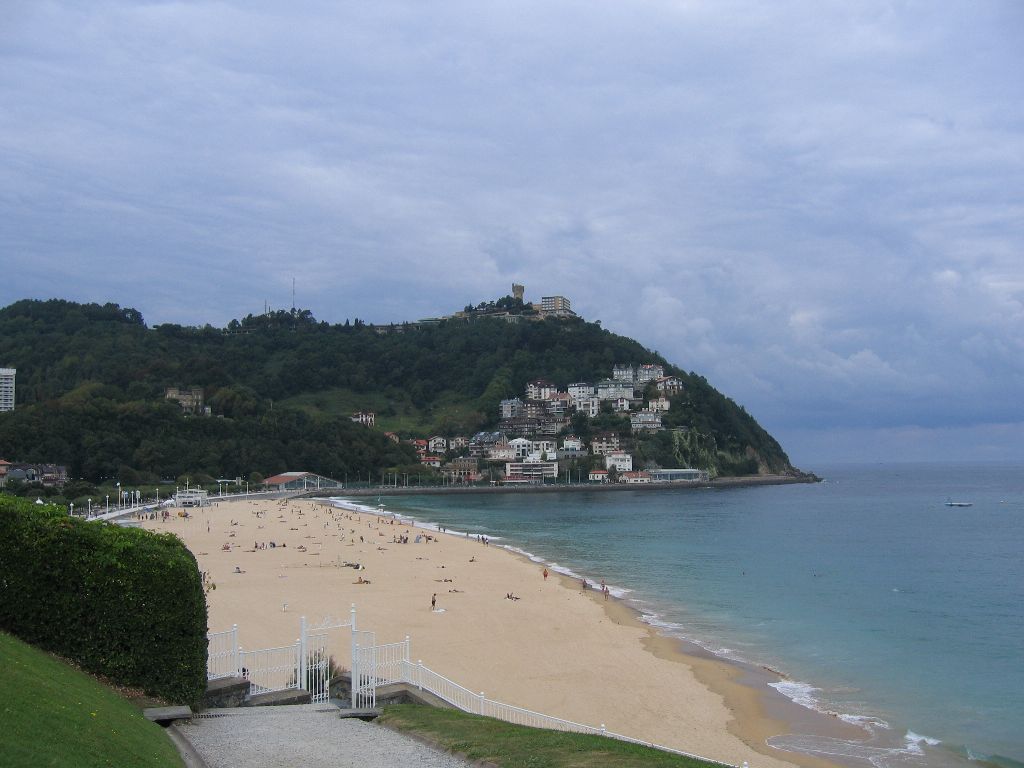
    San Sebastian 005You can see that it’s pretty nice. The old part of town has lots of nice ancient cathedrals and there’s a big statue of Jesus up on the hill which looks quite spectacular at night. I was more interested in the food by this stage as I had my appetite back! So we pottered about the town and had a meal, then the next day went back for more. It started to rain and I had my jandals on, the paving stones were slippery, like black ice, the next thing I knew I was on the ground and had shaken up my neck again.

    One of the beaches
    One of the beaches
    The other beach
    The other beach

    However I felt alright and we had another very good dinner of some sort of fish. The waiter was Columbian but he spoke good english, and helped us with the menu. All in all, it was a very good introduction to Spain. Next day (and my next post) we were off to Barcelona. Here’s the route we took, as you can see it’s from one coast to the other right across the middle.

  • Wow, this is me, doing a blog like a really modern person!

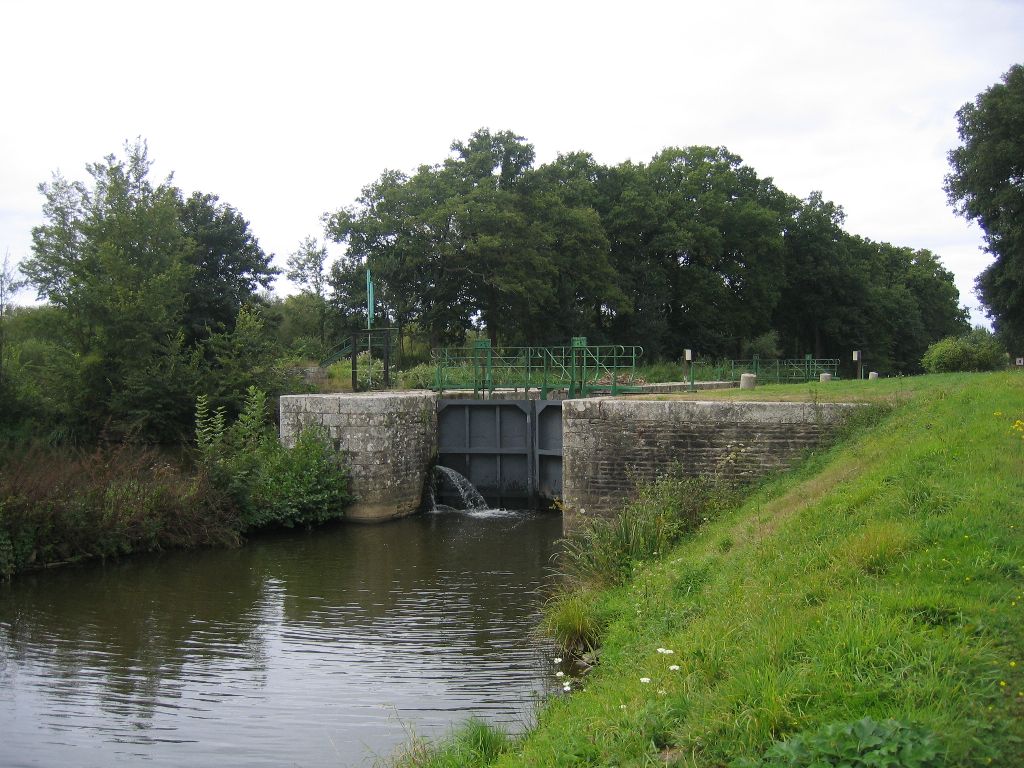
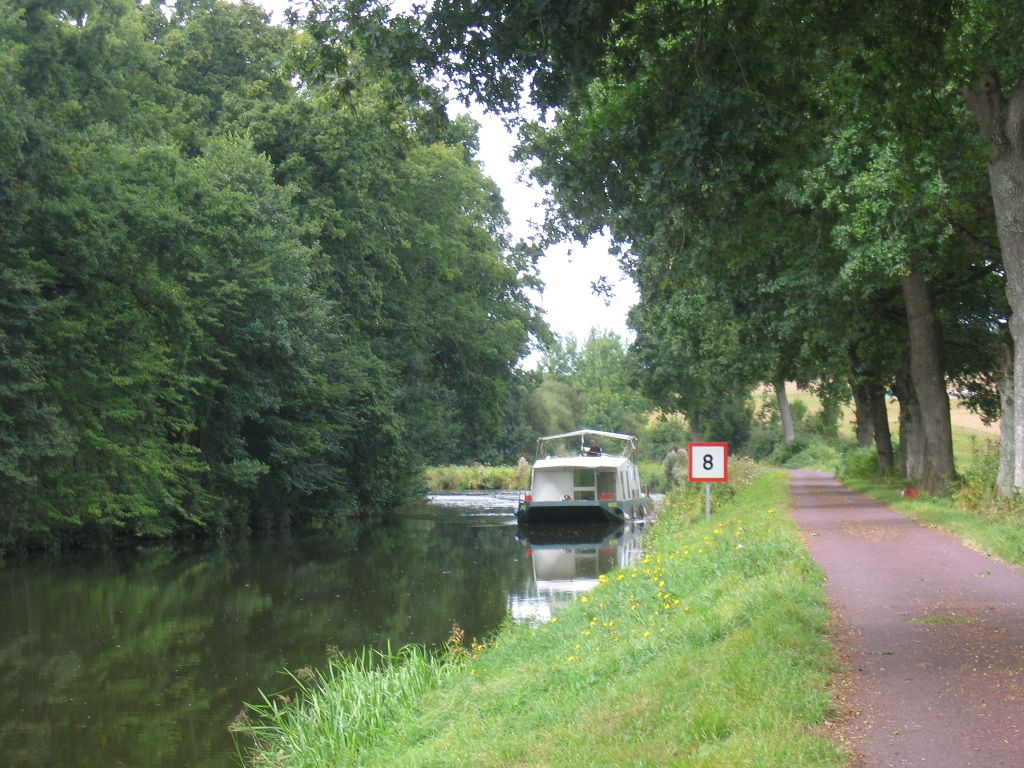
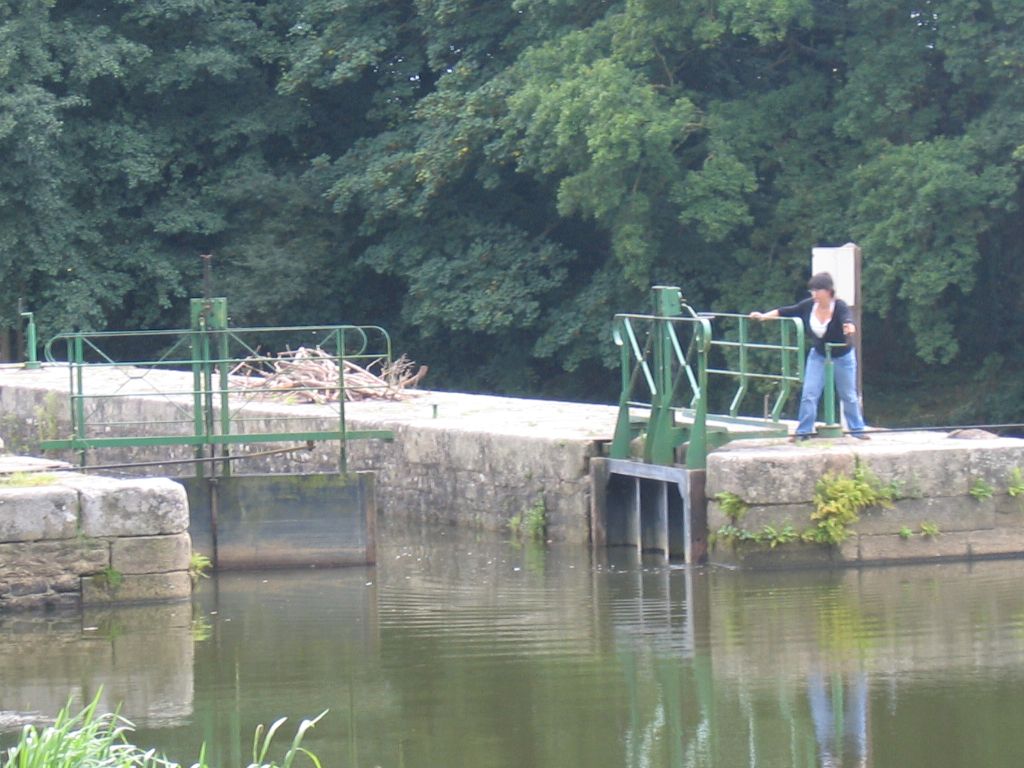
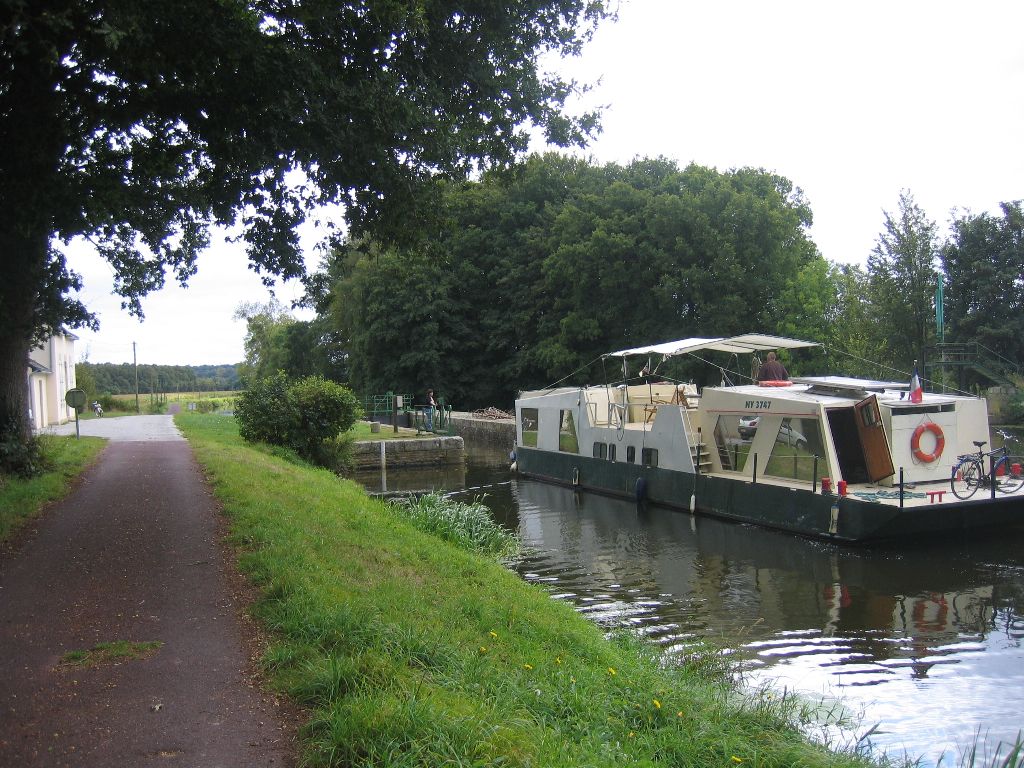
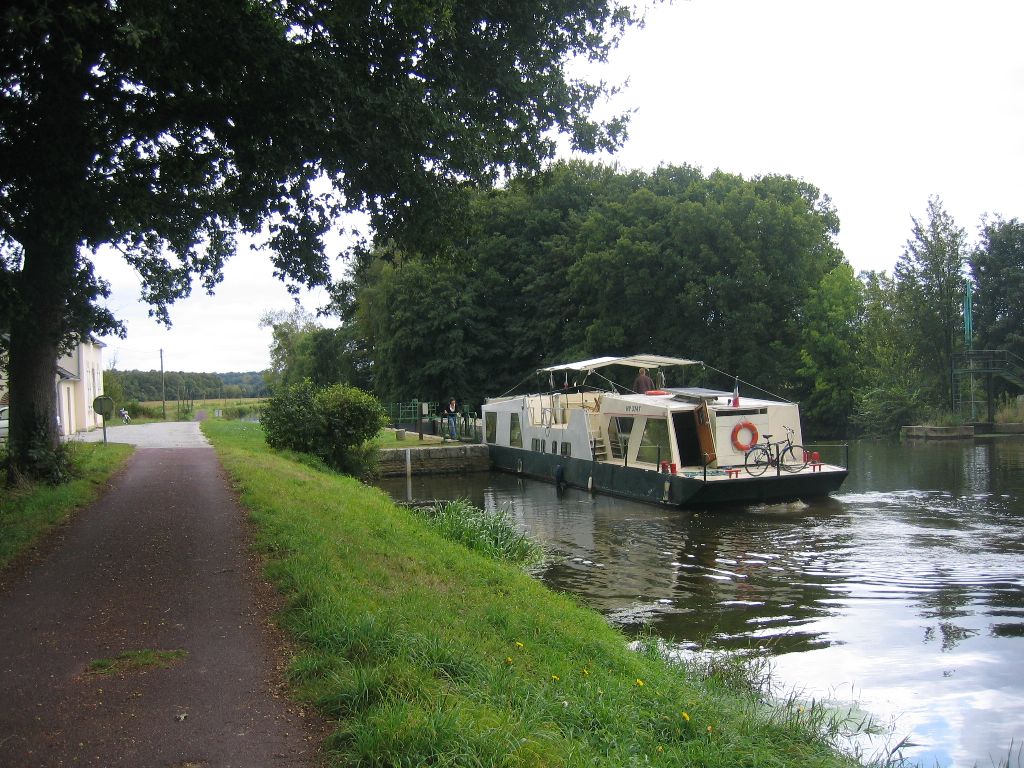
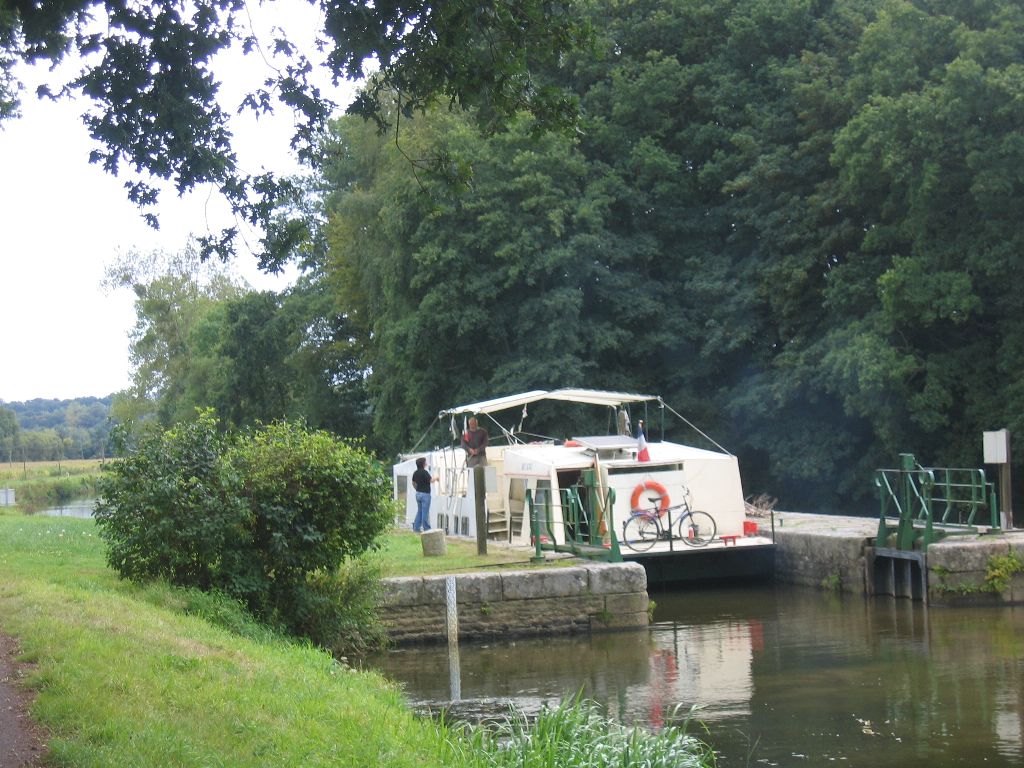
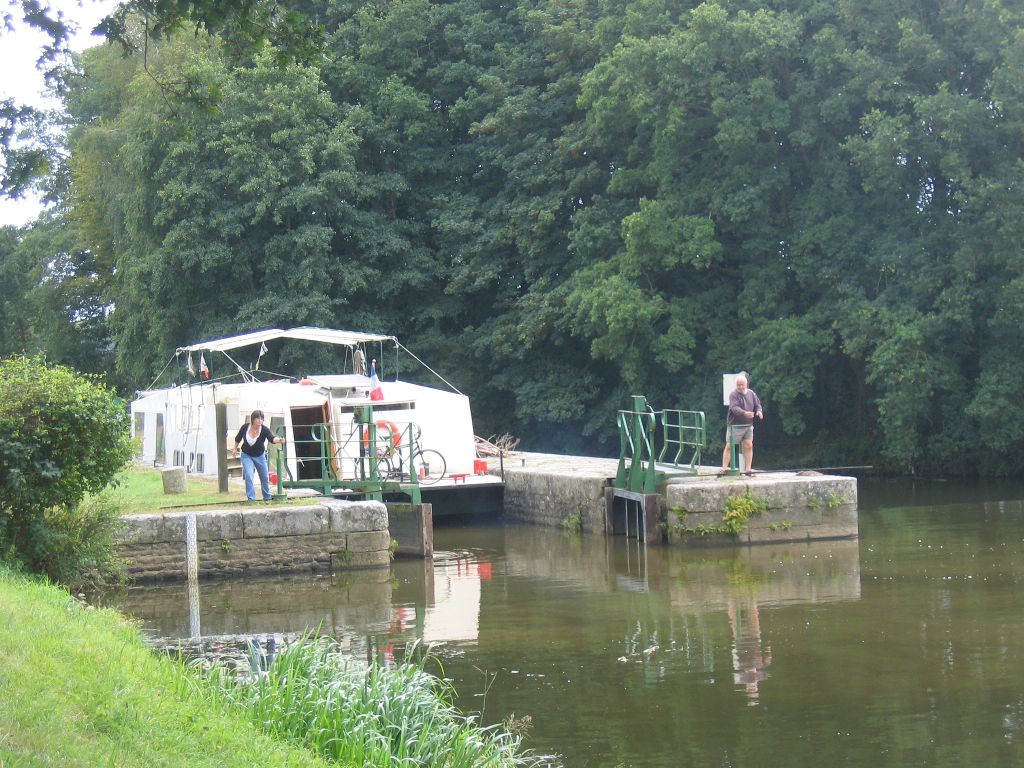
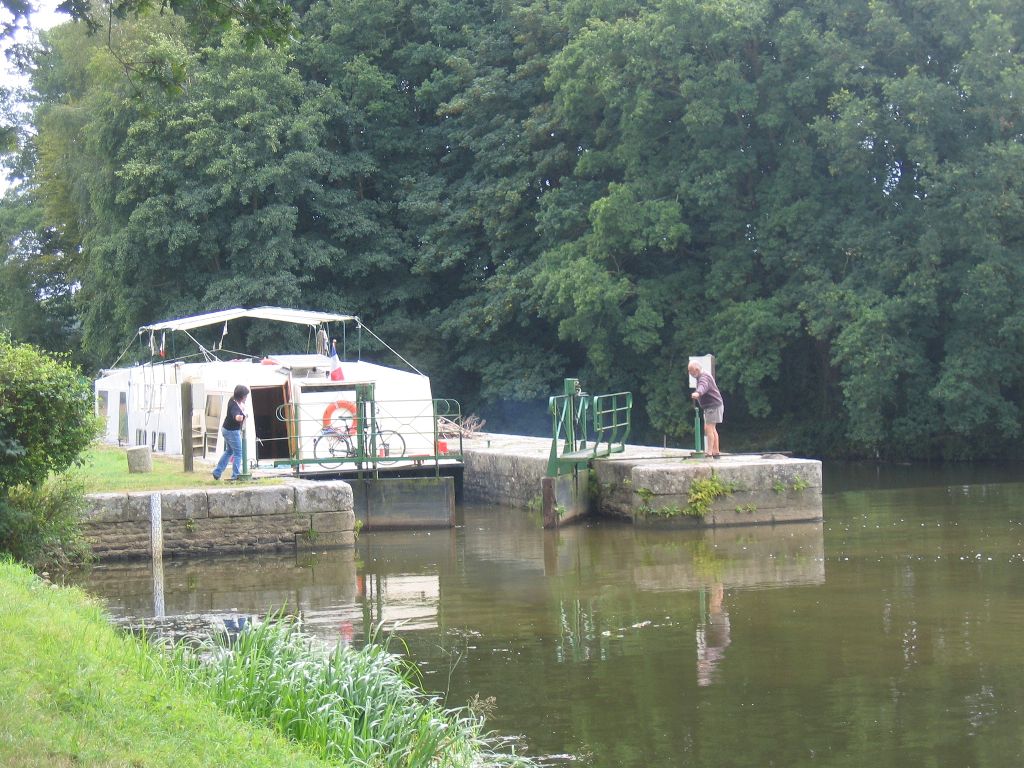
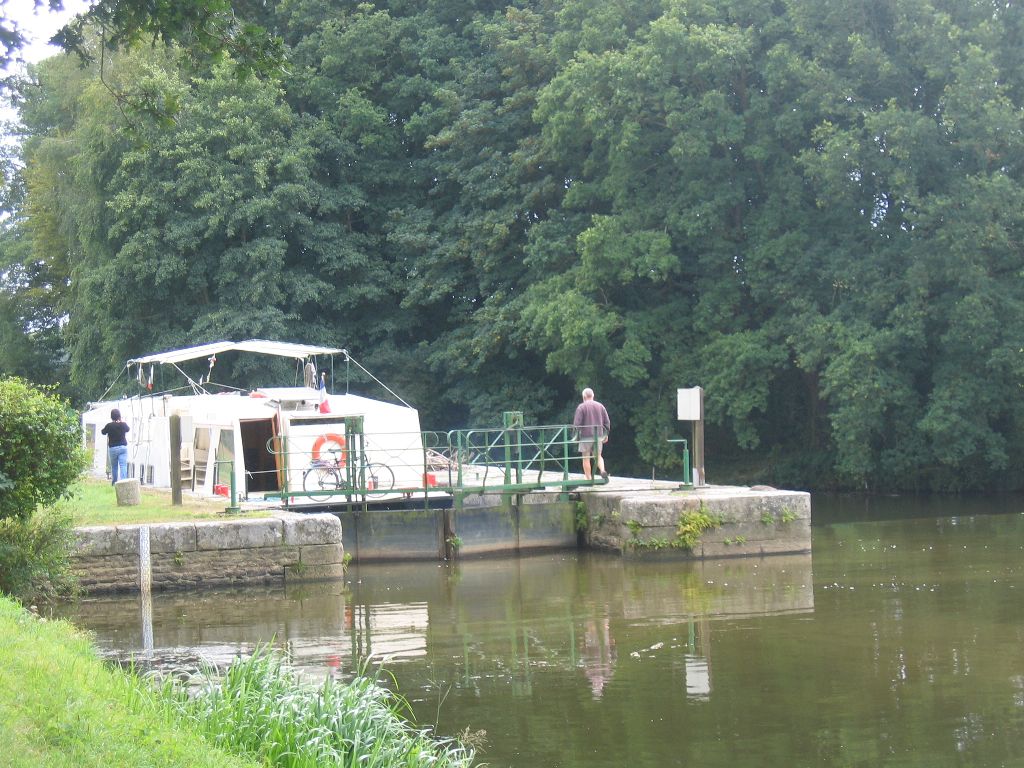
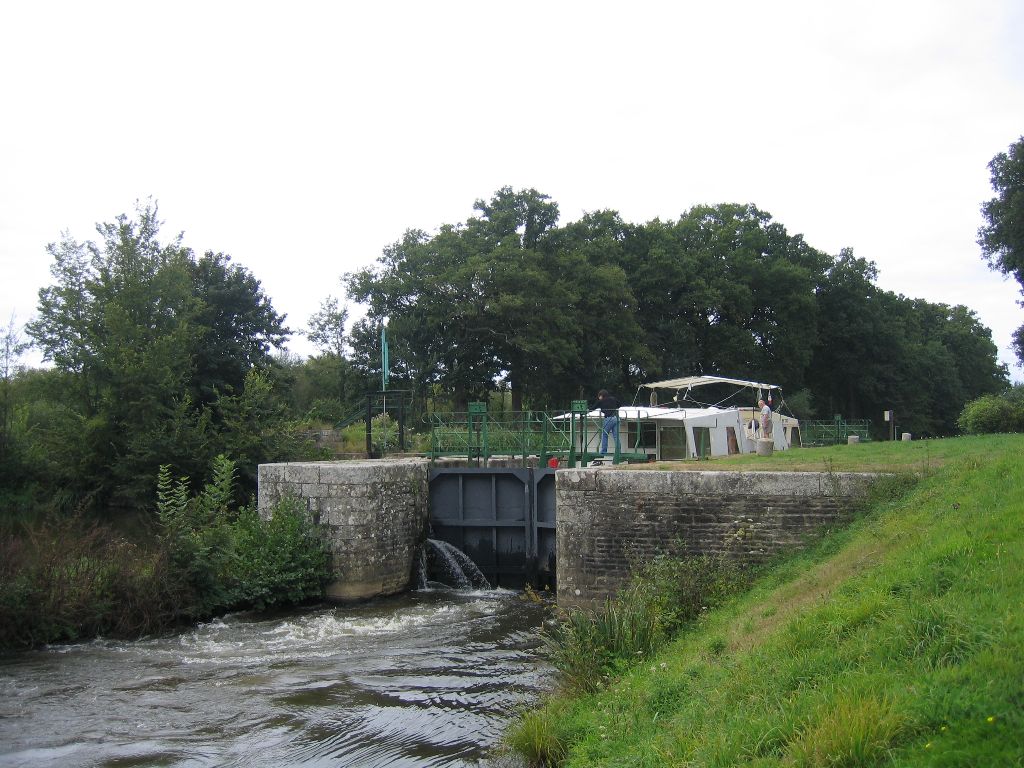
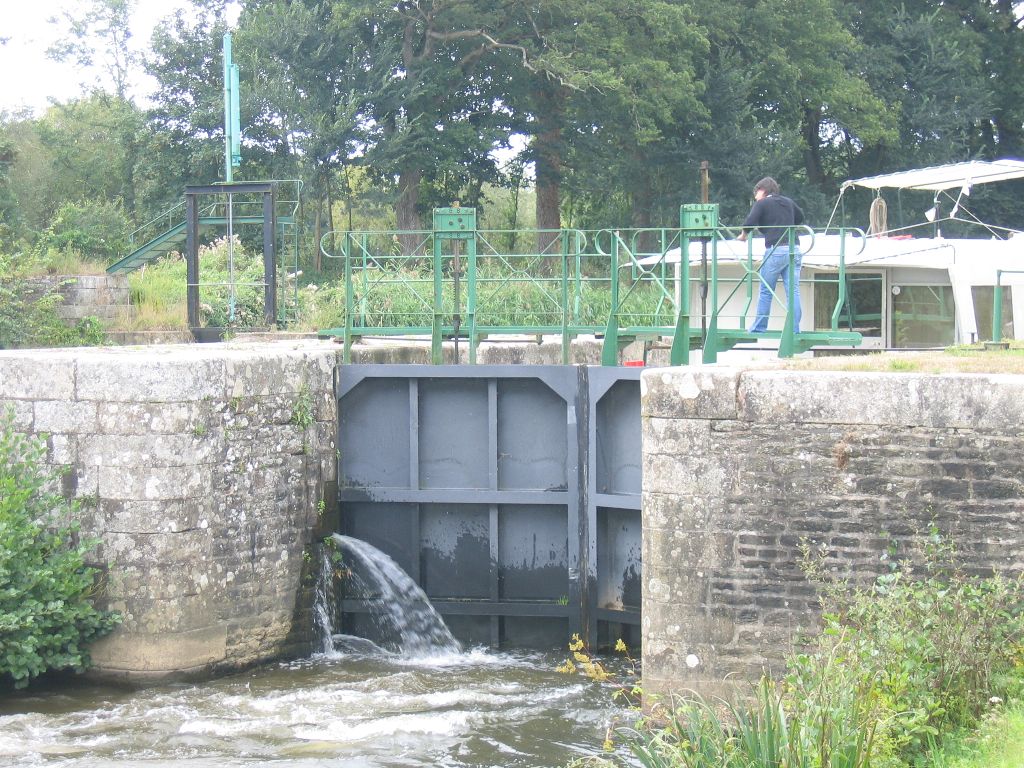
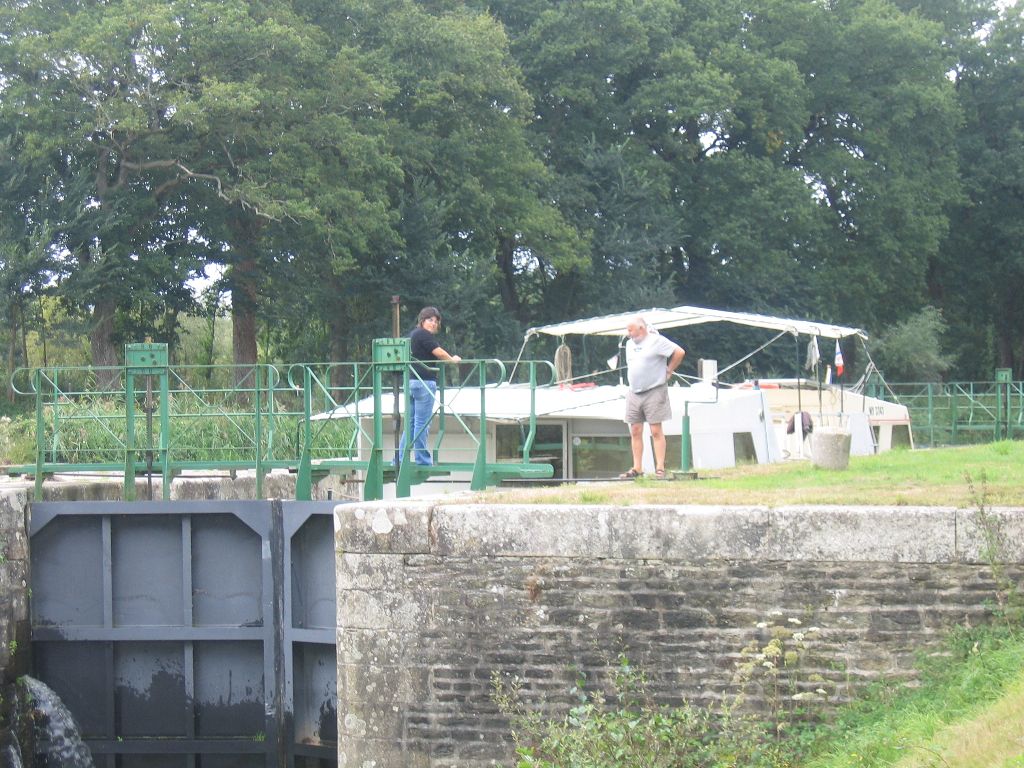
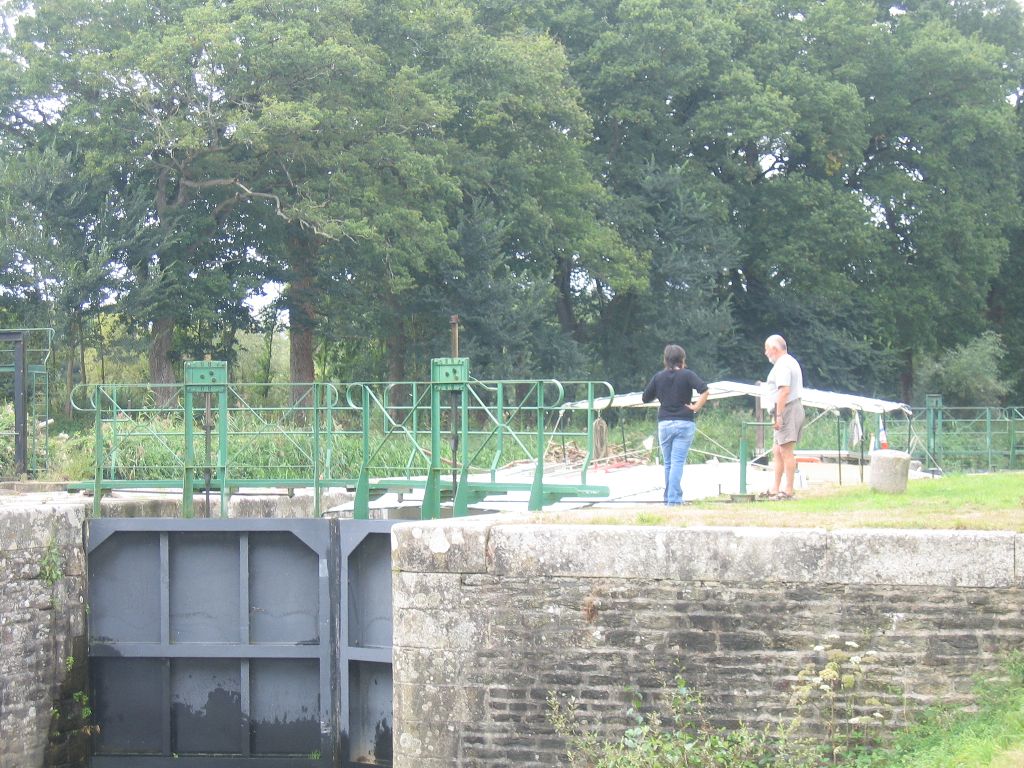
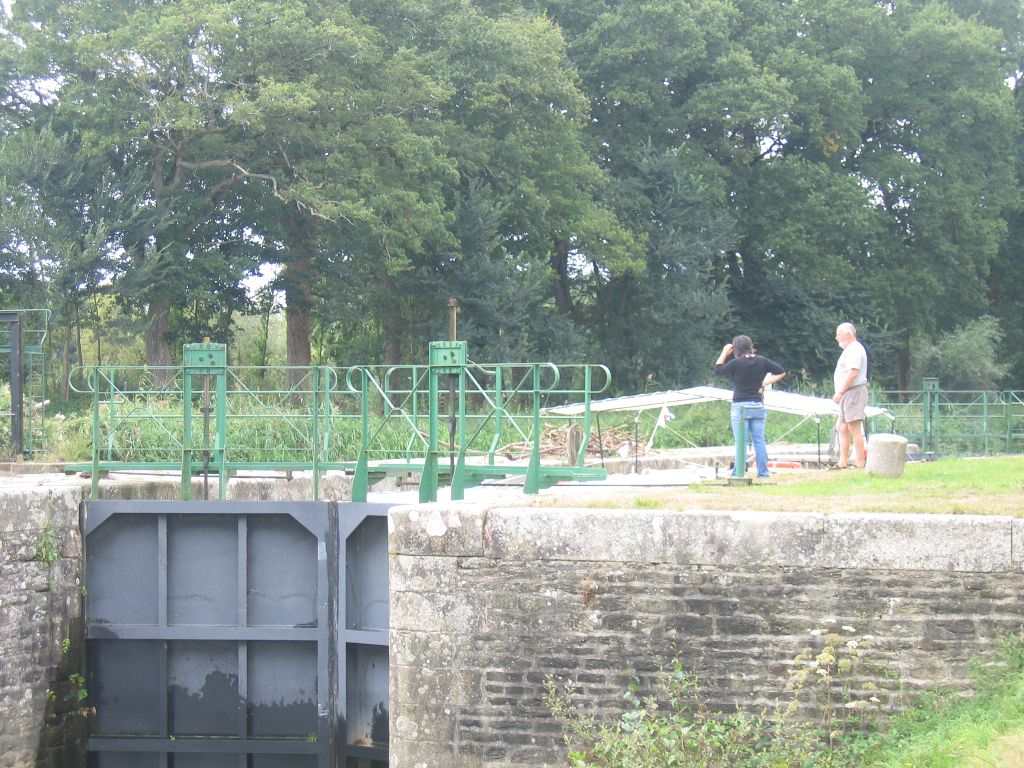
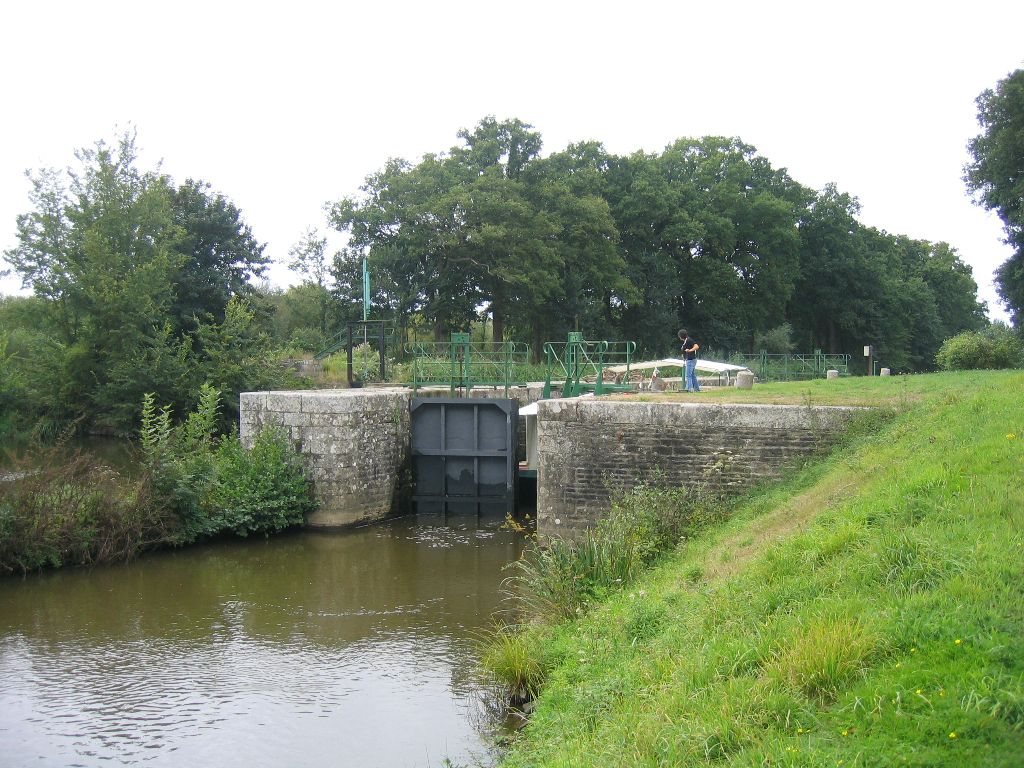
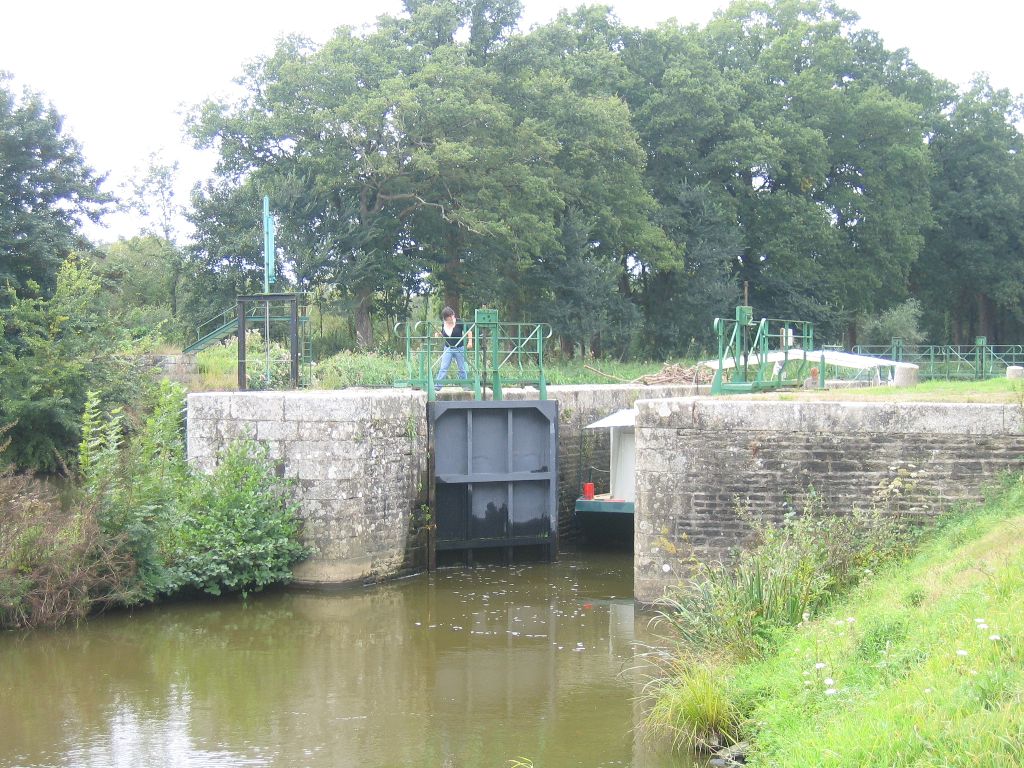
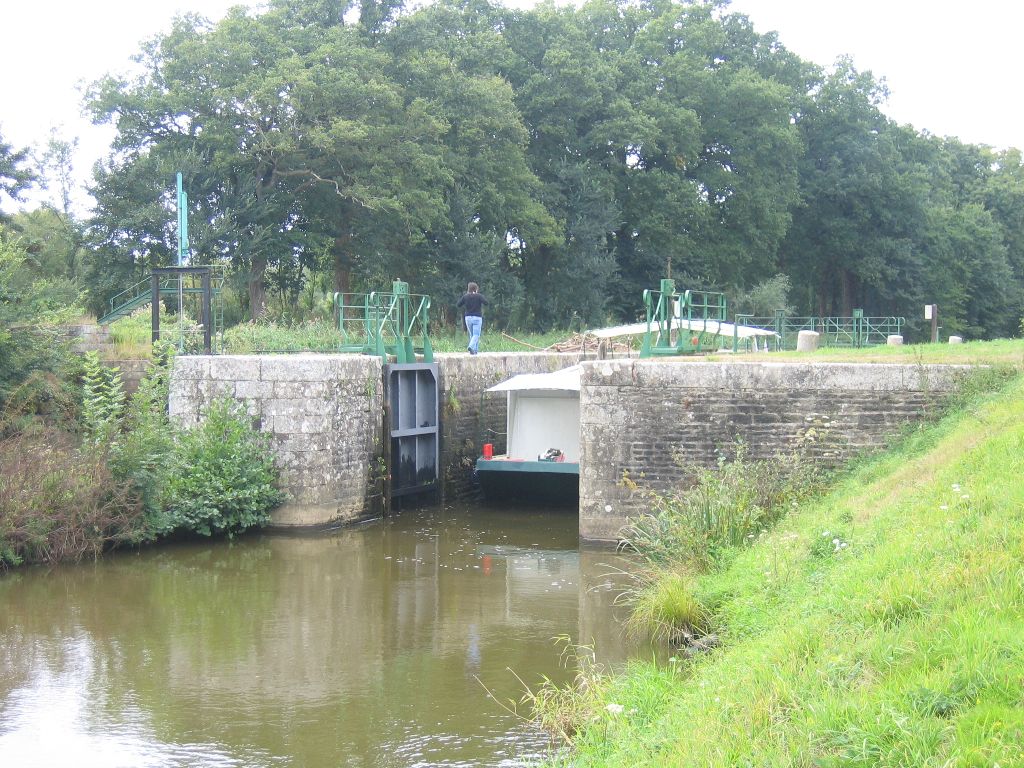
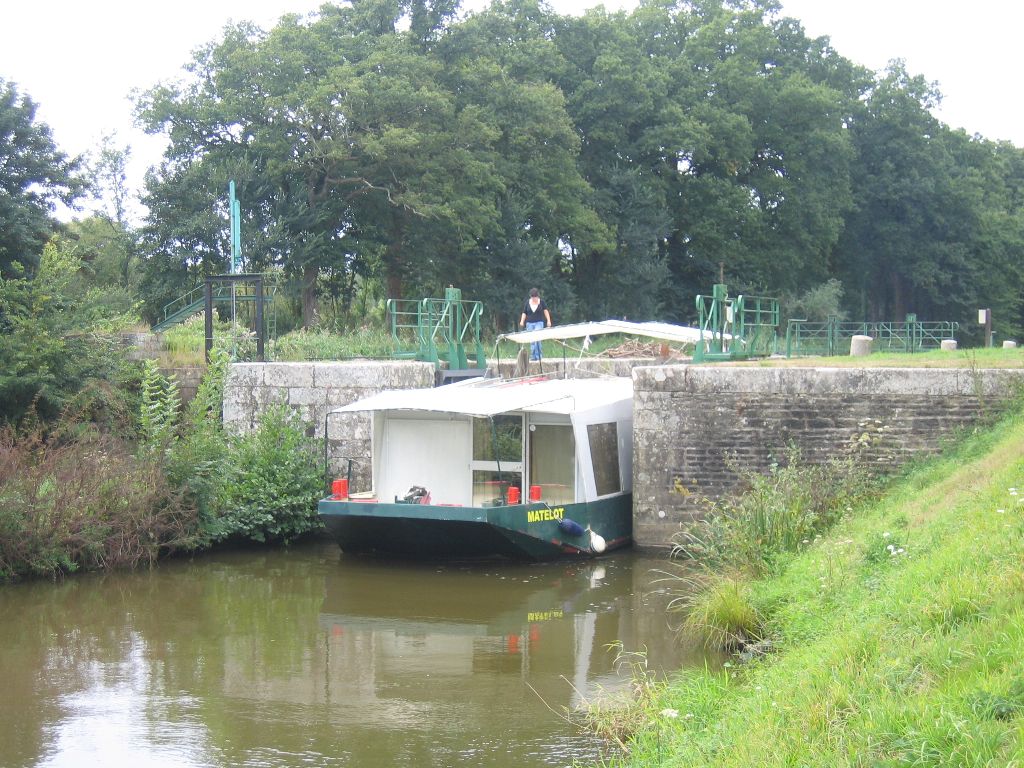
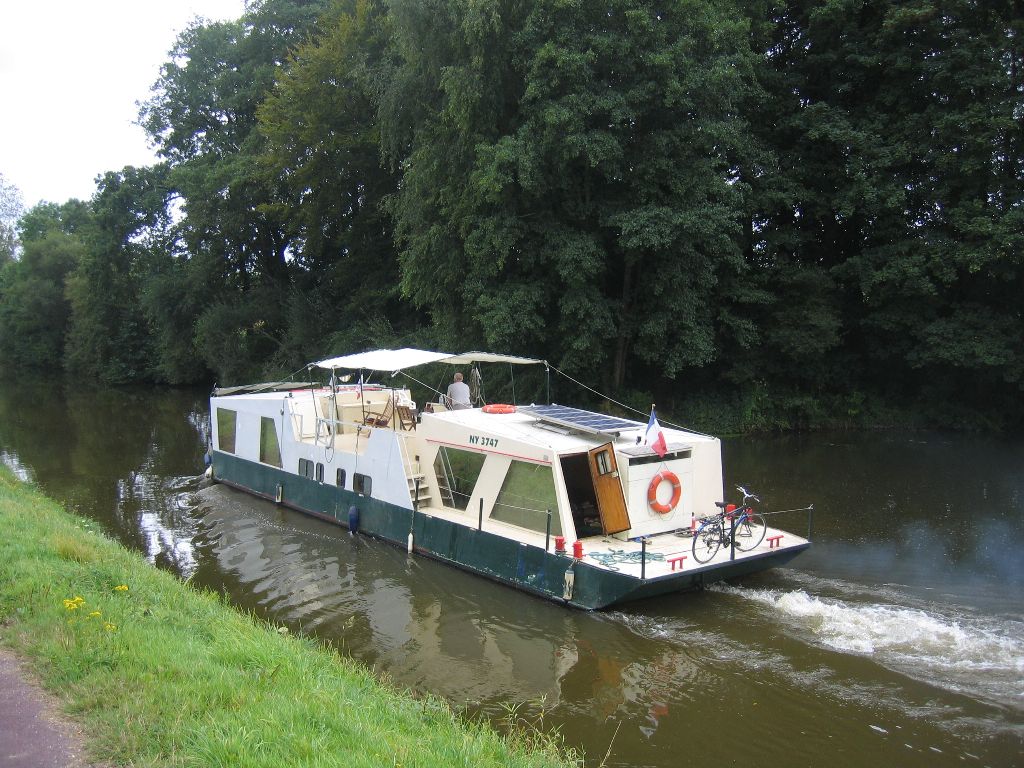
    This posting is mainly for Jared, to show him the canal and the lock system in France. In the old days they used to move lots of cargo around by barges (big flat boats) pulled by horses.  They made canals for the boats to go on, and they built locks to help the boats go up and down the hills. I went for a bike ride along the canal, and took photos of a boat going through a lock, to show you how it works.  Now the canals are used mostly by people on holiday who own or hire boats, and the paths beside the canals are used for walking and cycling. The locks are really cool, and lots of people watch whenever a boat goes through one, and if you’re really lucky the lock-keeper will let you help (especially boys around 8 years old!) I helped the lock-keeper close this one after I took the pictures.

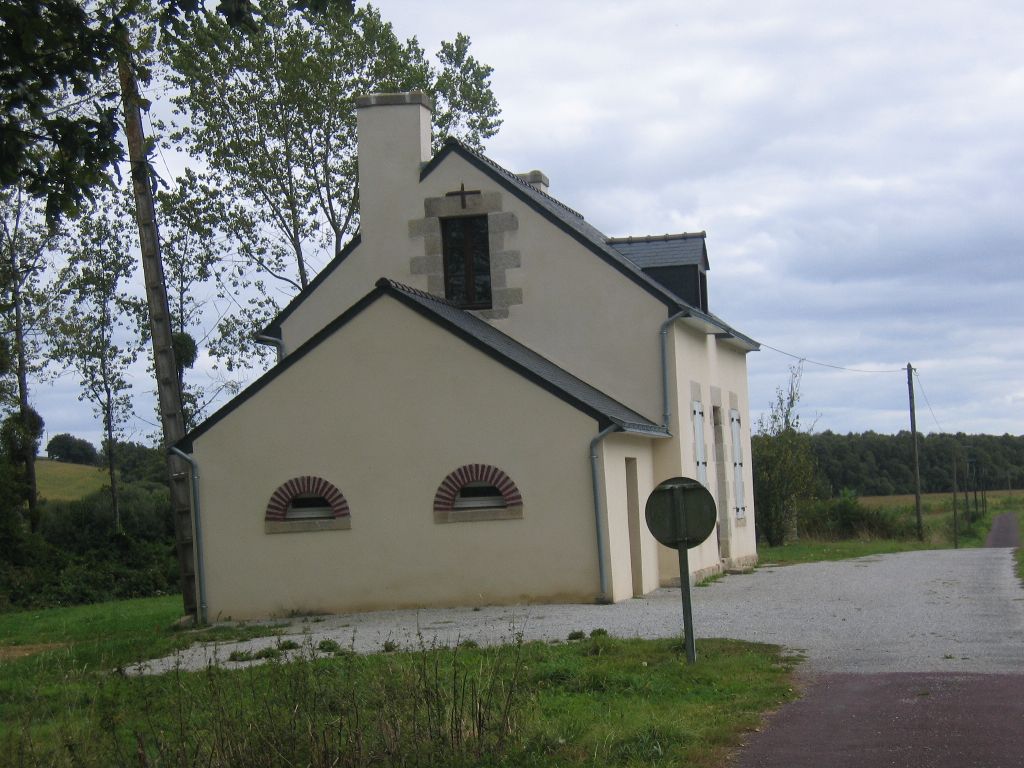
    This is a lock-keeper's house.
    This is a lock-keeper's house.

    Sometimes the lock-keeper lives in the house, sometimes they just stay there during the day to let the boats through.

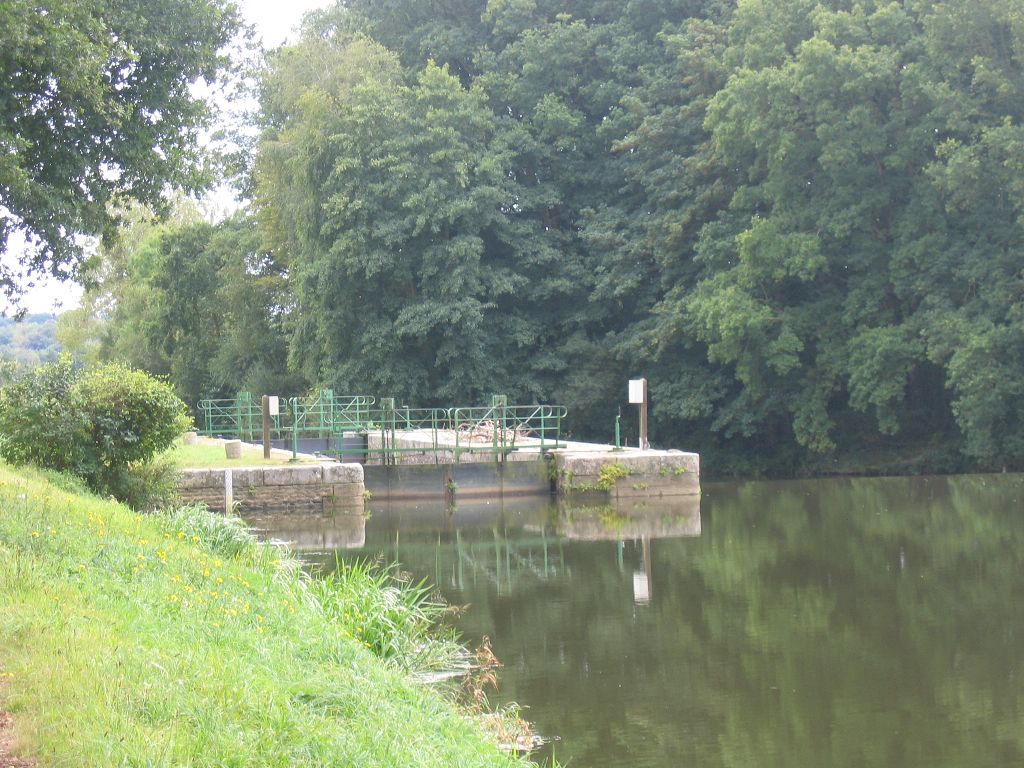
    the top of the lock
    the top of the lock

    This is where the boat will enter if it comes from up-hill

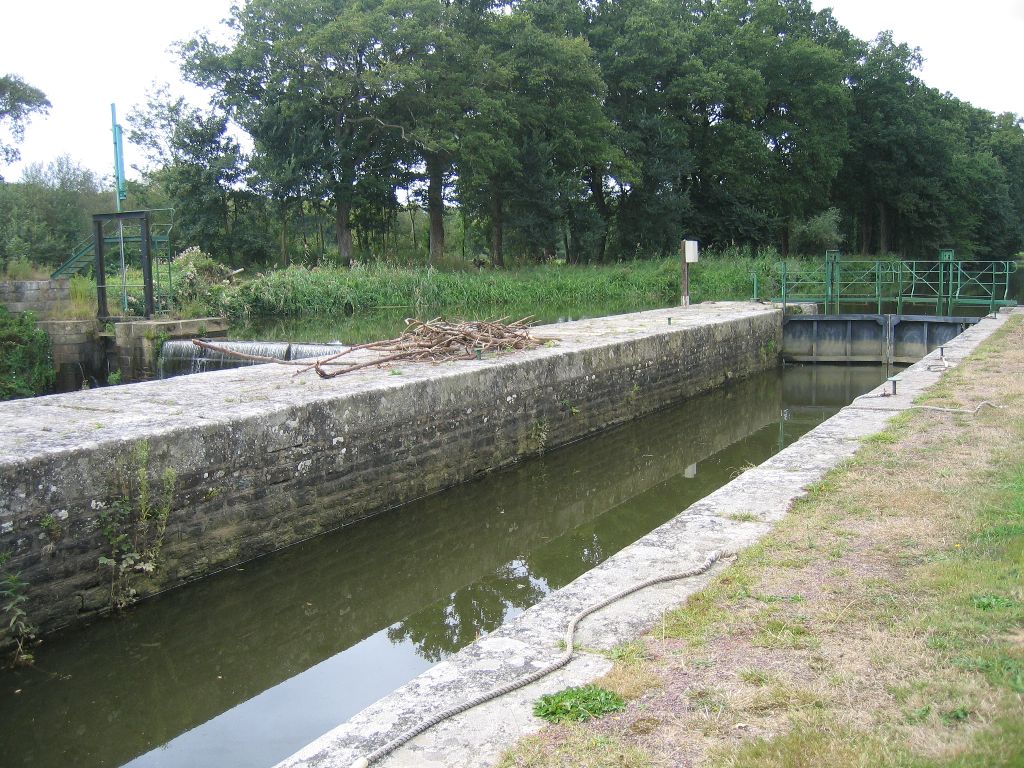
    the lock itself
    the lock itself

    This is where the boat will sit when it is going up or down.

    The bottom of the lock
    The bottom of the lock

    This is where the boat will come out if it is going down-hill.

    Here comes a boat!
    Here comes a boat!

    This boat is coming from up-hill, and it needs to get down the hill.

    so the lock-keeper starts to open the top gate...
    so the lock-keeper starts to open the top gate…
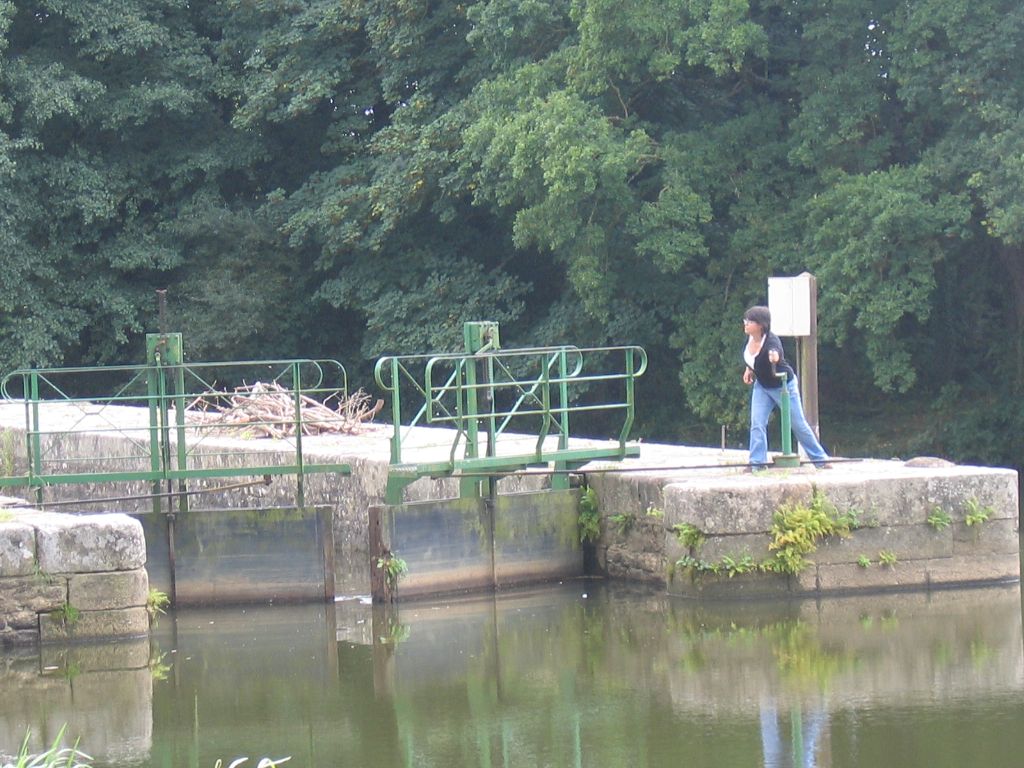
    she turns and turns to open the first gate...
    she turns and turns to open the first gate…
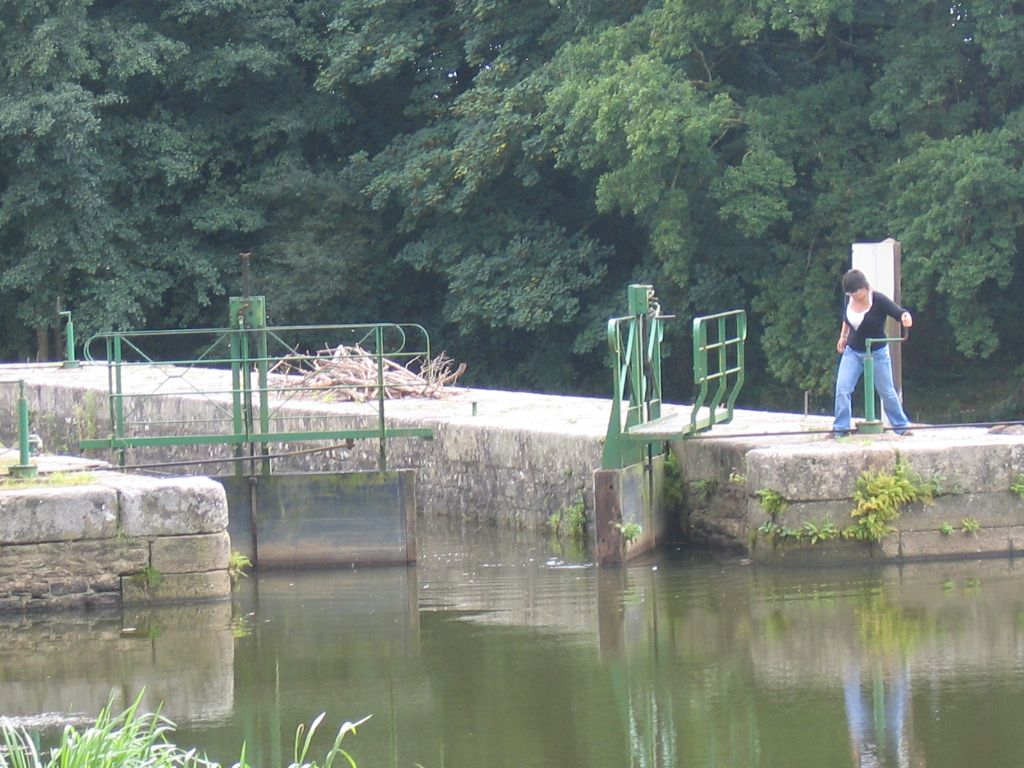
    she gets one gate open...
    she gets one gate open…

    and then she runs around to the other side to open the other top gate.

    The boat drives into the lock...
    The boat drives into the lock…
    slowly and carefully....
    slowly and carefully….
    it's a big boat...
    it's a big boat…
    so it's a tight squeeze!
    so it's a tight squeeze!
    The lock-keeper closes the top gate again.
    The lock-keeper closes the top gate again.

    The boat owner has to help her because there aren’t any 8 year old boys around.

    they turn and turn the levers....
    they turn and turn the levers….
    and finally get the top gates closed again.
    and finally get the top gates closed again.

    So the boat is now in the lock, and is at the level of the water up-hill. They need to let it down to the level of the water down-hill!

    so she starts to let some water out the bottom of the lock
    so she starts to let some water out the bottom of the lock
    and as the water comes out the boat sinks down
    and as the water comes out the boat sinks down
    If you look at the boat and the people's heads
    If you look at the boat and the people's heads
    you can see the boat dropping down...
    you can see the boat dropping down…
    and down, until it's at the level of the down-hill water!
    and down, until it's at the level of the down-hill water!

    So now it’s time to open the bottom gates to let it out.

    so again the lock-keeper has to open the gates herself
    so again the lock-keeper has to open the first gate
    and then the second gate all by herself
    and then the second gate all by herself

    because there are no eight year olds around to help.

    but when it's done the boat can leave the lock
    but when it's done the boat can leave the lock
    downhill...
    and sail off downhill…
    happily...
    happily…

    Hope you get to come to France and help with a lock sometime J

    xxx

    Pauline

  • We got up early in Josselin and caught the bus to Rennes, grabbed some lunch at the train station and picked up our hire car, which is a Citroen C3 diesel like this one except ours is green.  I was very pleased to get a diesel car

    Citroen C3
    Citroen C3

    as the price of diesel in Europe is about 1 euro per litre whereas petrol is 1.40 or $2.90 nzd per litre! Also a diesel car is more economical to run, being more efficient. While it occasionally sounds like a tractor, most of the time you would not know it was a diesel as it is quite responsive and zooms along the autoroute at 130 very happily. (Thats the legal speed limit by the way.)

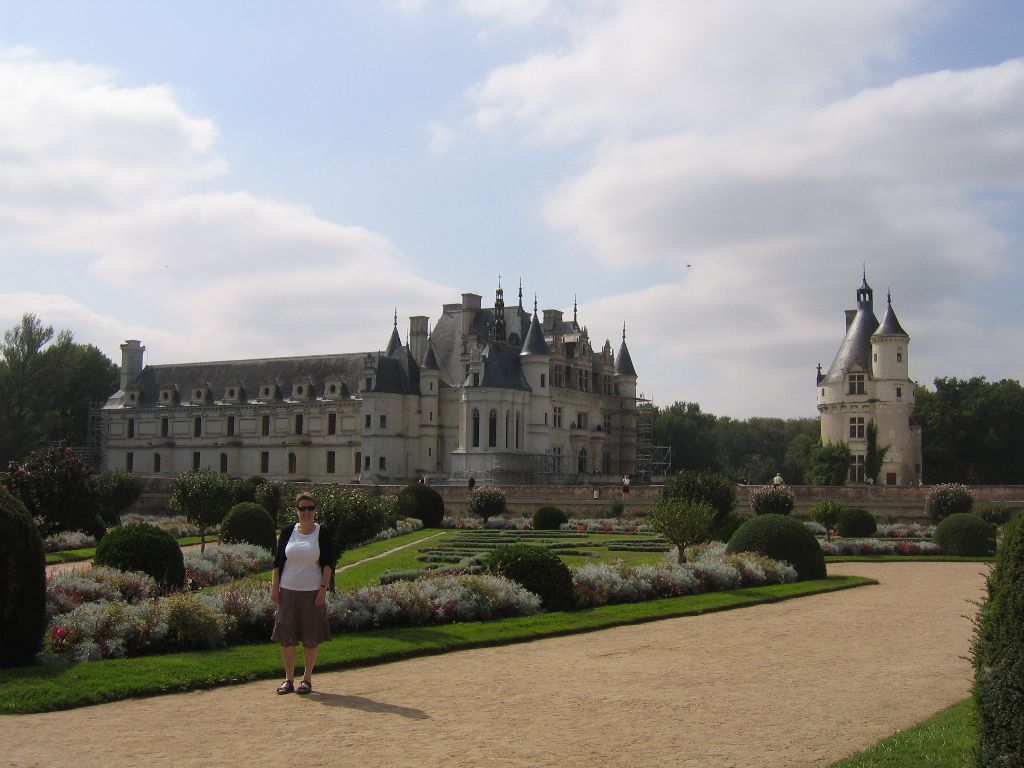
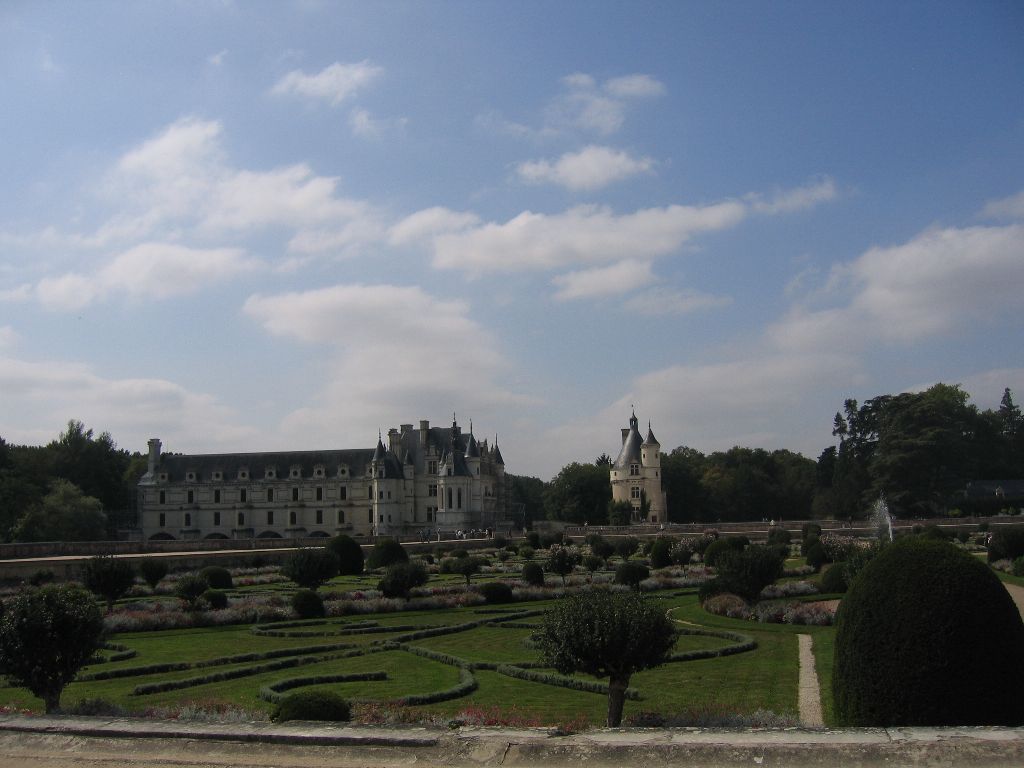
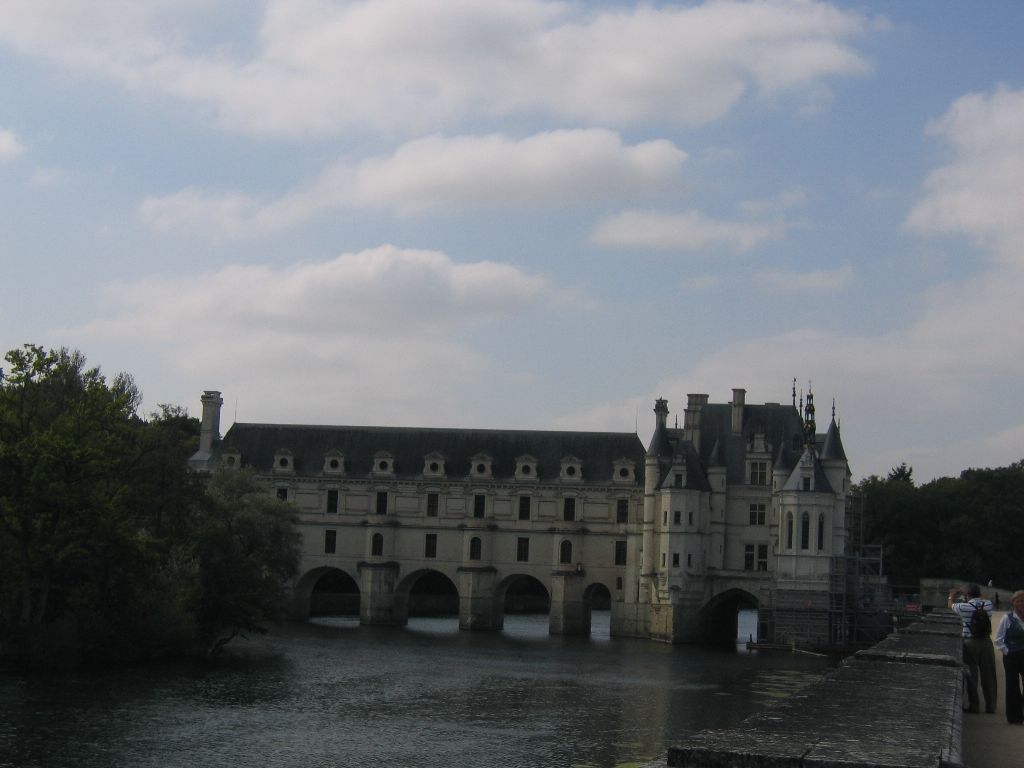
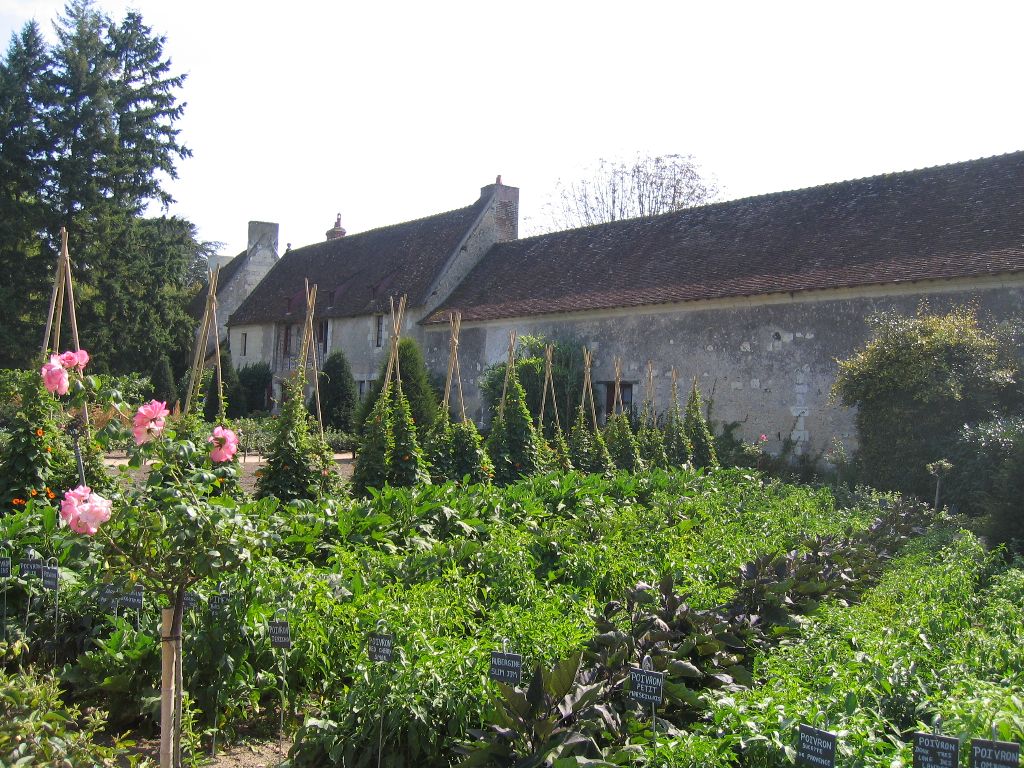
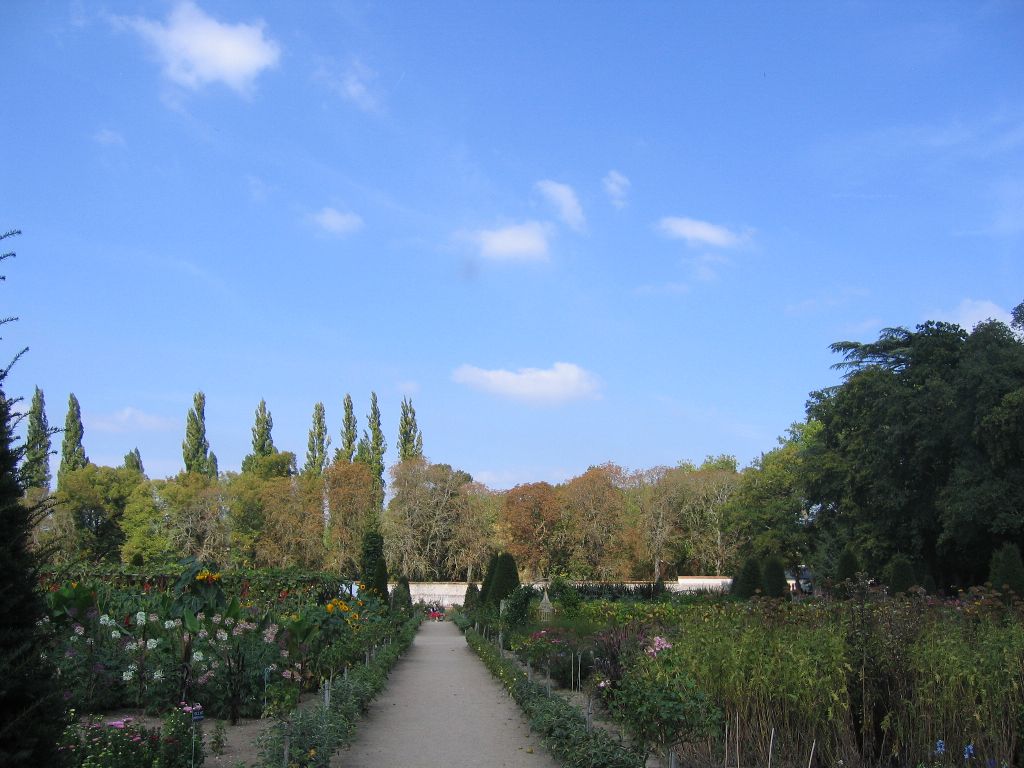
    We headed towards the Loire Valley on the autoroute, arriving at our Chambre D’hote Les Perce Neige (the snow drops) late afternoon, in the little town of Vernou sur brenne, quite close to Tours. A Chambre D’hote is a B&B. This one was quite charming, with wicker furniture and also a wicker floor covering, and a large private back yard with sun chairs and tables. So we had a drink and read our books in the sun, then drove to nearby Vouvray for an excellent dinner. Next day, after a good breakfast and being entertained by the cat drinking from a vase of flowers in the kitchen, which it apparently does every day, we were off to the Château de Chenonceau about 26 kms away. The castle was built between 1515 and 1521 and was owned by Henry II’s mistress Diane de Poitiers and subsequently Henry’s widow Catherine de’ Medici. Here are some photographs. The castle is currently under restoration so there was some scaffolding about. There were also some amazing vegetable gardens so we took picutes of that also. More of the trip down in my next post.

    Vernou sur brenne
  • We are currently in San Sebastian, Spain. The header of this blog is now a panorama of the bay, as you can see it’s rather pretty. We are staying here a couple of days, I will post some more tomorrow. Adios amigos!